




One year ago, Congress defunded public media. Now that we're 100% community funded, please become a sustaining member or increase your existing membership today.
At $27 each, they might be LA’s most expensive tamales — but are they worth it?


At Sí! Mon in Venice, Chef José Olmedo Carles Rojas puts his spin on Panamanian tamal tradition with a rich, lamb neck version.
(
Gab Chabrán
/
LAist
)
Growing up in Whittier, tamales have always been part of who I am — whether from local bakeries like La Moderna, where my mother always orders the day after Thanksgiving, or our annual tamalada with family friends, where we churn out hundreds in slightly drunken assembly-line fashion.
Over the years, I've explored beyond the traditional Mexican versions: El Salvadoran styles from What's That You're Cooking in Orange County to the Chinese lo mai gai found at dim sum spots across the city. My pursuit of new tamal variations is relentless, especially this time of year.
So when I heard about a $27 lamb neck tamal in Venice, I had to know: could an elevated, chef-driven approach ever justify that price? Since a few other restaurants are also recreating the humble dish with a high-end approach, I decided to go and try them.
What I discovered was that these aren't replacements for traditional tamales — they're explorations of what happens when fine dining ambition meets this centuries-old form.
-
 LAist sat down with the general manager of Keno's Restaurant in Anaheim Hills, where you can find a 15-pound burrito or a 32-ounce Tomahawk steak.
 -
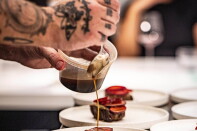 Darkroom trades curb appeal for creative freedom — and locals can't get enough of what's coming out of the kitchen
 -
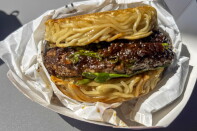 Keizo Shimamoto is serving some of Southern California's best ramen under the radar in Orange County.


Si! Mon (Venice)
Si! Mon opened in 2023 in the former James Beach space, a collaboration between chef José Olmedo Carles Rojas and restaurateurs Louie and Netty Ryan, known for Venice-adjacent mainstays Hatchet Hall and Menotti's Coffee Stop. Si! Mon offers Carles Rojas' take on Panamanian fine dining, drawing on Panama's melting pot of Chinese, French, Spanish, African and Caribbean influences.
Sponsored message
For the holidays, Carles Rojas is offering a $27 lamb neck tamal — a clear departure from the Mexican versions most Angelenos know. And while the price might cause some sticker shock, it’s worth considering what goes into it and how much food there is.
Wrapped in a banana leaf, the tamal uses a lighter, softer masa enriched with the lamb neck’s braising liquid. Rojas pulls the meat, tosses it with sofrito until it takes on a sauce-like consistency, then adds Indian-style quick-pickled dates for sweetness and olives for brine. Finally, the tamal is finished in Si! mon's wood-fired oven, adding subtle smokiness.
My verdict? After taking that first bite, I can tell you… it’s worth the splurge. One tamal is meant to be shared between two people, which partly explains the price point (though I had no problem finishing mine solo). I’ve had plenty of Central American tamales over the years — Salvadoran versions with their silky masa, Nicaraguan nacatamales loaded with vegetables and pork — but Carles’ take pulls out all the stops. This is a deluxe, bells-and-whistles vision: sweet, salty, and deeply savory all at once, comforting yet unlike anything I’ve tasted before.
Yes, it is a high price, but I’d say it reflects the time, technique and premium ingredients behind it.
Location: 60 N. Venice Blvd., Venice
Hours: Monday through Thursday, 5 to 10 p.m., Friday through Saturday, 5 p.m. to midnight, Sunday, 5 to 9 p.m.
KOMAL (South L.A.)

A Guatemalan-style chuchito tamal from KOMAL at Mercado de Paloma in South L.A.
(
Frank WonHo
/
Courtesy KOMAL
)
Sponsored message
KOMAL is L.A.'s first craft molino (mill), founded by Fátima Júarez and Conrado Rivera, former employees of Michelin-rated Holbox, who opened this masa-centric counter inside South L.A.'s Mercado La Paloma. The name is Nahuatl for "comal," the traditional flat griddle used to cook tortillas.
I wanted to try the chuchito ($11), a regular menu staple at KOMAL. Júarez refers to the dish as a gift — both for the unwrapping it requires and the labor of love behind it. Each one takes more than 22 hours to make, starting with nixtamalizing heirloom corn to create the masa. (Nixtamalization, an ancient Mesoamerican process, involves soaking and cooking corn in an alkaline solution to improve its flavor, texture, and nutrition).
The result is a fluffy steamed tamal filled with tender pork and crowned with roasted pepper and tomato sauce, pickled cabbage and vegetables, and crema. The dish honors her kitchen team, most of whom are from Guatemala, and it's KOMAL's way of putting their heritage front and center on the menu.

KOMAL’s strawberry tamal dulce comes bright red and crowned with pineapple and fruit compote.
(
Frank WonHo
/
Courtesy KOMAL
)

Komal’s tamal verde at Mercado de Paloma comes stuffed with tender chicken and topped with zippy green salsa.
(
Frank WonHo
/
Courtesy KOMAL
)
Beyond the chuchito, Júarez is offering three special tamales as holiday pick-ups for Christmas and New Year's: a deep, complex tamal rojo filled with sweet corn and squash calabacita, a vibrant tomatillo-based tamal verde filled with chicken, and a tamal de leche made with oranges and strawberry jam, a sweet version that hints at the pre-Hispanic tasting menu they're developing.
After the holidays, these tamales will transition to appearing exclusively at Komal's planned ancestral and ceremonial dinners in 2026 — making this a rare chance to try them before they become part of a more formal dining experience.
Available by the half-dozen ($45) or the dozen ($90), they can be ordered for pick-up at KOMAL on Tuesday, Dec. 23, or Tuesday, Dec. 30.
Sponsored message
Location: 3655 S. Grand Ave, Los Angeles
Hours: Wednesday through Sunday, 11 a.m. to 9 p.m. Closed Monday and Tuesday.
Campesino Café at The Ecology Center (San Juan Capistrano)
Aaron Zimmer, head chef of Campesino Café at The Ecology Center, works within a unique constraint: everything on his menu comes from the 28-acre regenerative organic farm surrounding the restaurant. That includes the corn he grows, dries, harvests and processes into masa for his tamales.
For the winter season, Zimmer is offering two versions that reflect what's abundant on the farm right now. The shelling bean and cheese tamal ($21) features beans from one of four varieties they grow on-site — shelling beans are harvested before they're thoroughly dried, prized for their creamy texture and delicate, earthy flavor. The cooked-down beans are incorporated into the fresh masa with cheese, then topped with chili con queso made with pickled giardiniera from their summer harvest.

Campesino Café’s tamal duo pairs winter squash in walnut mole with a shelling-bean-and-cheese tamal topped with chile con queso.
(
Gab Chabrán
/
LAist
)
The winter squash tamal ($21) features squash finished with a walnut mole sauce. The sweet, nutty texture, combined with the squash's sweet, earthy flavors and soft, fresh-tasting masa, creates a highly multidimensional bite.
Both are wrapped in masa and steamed in corn husks, then topped with whatever's available in the larder at any given moment, such as freshly grown cilantro or pickled onion.
Sponsored message
It's a hyperlocal, intensely seasonal approach that makes each tamal a snapshot of what the farm is producing — versatile, sustainable, and entirely tied to the land it comes from.
Location: 32701 Alipaz St., San Juan Capistrano
Hours: Open daily, 9 a.m. to 2 p.m.

Senior Vice President News, Editor in Chief


