




One year ago, Congress defunded public media. Now that we're 100% community funded, please become a sustaining member or increase your existing membership today.
California created a new grade for 4-year-olds, and it's re-energizing teachers

Susana Alvarez, left, leads the class in singing happy birthday and feliz cumpleaños to TK student Melrose at Lucille J. Smith Elementary in Lawndale.
(
Mariana Dale
/
LAist
)
Listen
3:40
California created a new grade for 4-year-olds, and it's re-energizing teachers
Education researchers say happier teachers are more likely to stay and that stability can be good for long-term learning outcomes.
Marguerita Elementary School teacher Claudia Ralston spends most of her day on the floor, guiding her transitional kindergarten students through play. She said if it weren’t for TK, the Alhambra educator would be considering retirement.
“Yes, I am exhausted,” Ralston said. “But just being here for the children and doing all the different activities … their curiosity, them wanting to learn just gives you that extra energy.”
This school year is the first where every 4-year-old in the state can enroll in the universal preschool program, also called TK, at their local public school. Schools need to hire an estimated 12,000 teachers to staff the program. Some may come from child care settings and preschool programs, but others are veteran educators who’ve gone back to school to get the credential required to teach TK.
And once they get into the TK classroom, many educators told us, they’ve found new joy in the work.
Lauren Bush started teaching transitional kindergarten three years ago after more than two decades coaching other educators and teaching every grade from kindergarten through sixth.
Her classroom at Lucille J. Smith Elementary in Lawndale is broken into different “centers,” where students can play with colorful magnetic tiles, practice painting their name or construct a ramp to roll a ball from one end of the room to the other.
“It was just so joyful to be with the kids again,” Bush said. “That's when I just, like, got back to myself as an educator, and now I'm gonna die here. That's my plan. I love it here.”
Sponsored message
Education research shows that teachers who like their jobs are more likely to stay, and that stability can be good for long-term learning outcomes.
So we wanted to understand what makes TK so joyful for educators and how that can shape how and what students learn.

Lauren Bush and her students practice saying the sounds associated with the letter 'A' at Lucille J. Smith Elementary in Lawndale.
(
Mariana Dale
/
LAist
)
Welcoming students with joy
Broadly, the goal of transitional kindergarten is to prepare students for kindergarten and beyond.
“I wanna make sure that their first experience in a public school setting is one that is joyful, where they feel loved, where they feel welcomed, where they get to really transition nicely into like the rigor of the school,” Bush said.
California’s learning foundations for preschool and transitional kindergarten include academic concepts, like the alphabet and writing, but also learning about emotions and developing kids’ muscles.
Sponsored message
“The progress in academics in the lower grades is so satisfying because it's such a huge, huge jump,” Bush said. “You don't necessarily see that in the upper grades. It's so gradual… They come into me not knowing how to hold a pencil, and they leave writing their name and drawing.”
That’s why Bush has her students tear paper, to hone the fine motor skills that will be useful to one day using a pencil.
“Yes, they're playing all day, but it's very intentional play,” Bush said.
-
 California has made a new grade, transitional kindergarten, available for four-year-olds. LAist reporters spent a day in three schools to find out what students do in class.
 -
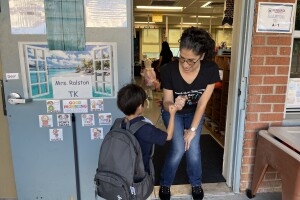 Some teachers are making the switch from private preschools to transitional kindergarten. Others come from upper grades. Many are needed.


Teachers also told us without the pressure of standardized testing, there was flexibility to tailor their instruction to students’ interests.
“I can take something that they're curious about and go from there and do little mini lessons with that,” said Alhambra TK teacher Claudia Ralston.
For example, when she noticed a group of students was ready to practice writing, she set up the materials for them to make signs. The subject of the signs, pumpkin pies and pumpkin drinks, was a topic they’d previously expressed interest in.
Sponsored message
And while every school is different, she said in her experience, there are also fewer worksheets used in TK than other grades.
“Before, we used to have to run off a lot of copies,” Ralston said. “We're not doing that. It's all hands on.”

Samantha Elliott, a first-year TK teacher at Price Elementary School in Downey, said she starts the year focused on friendship and manners. "If [the students] don't feel safe or welcome, then there's really no learning going on there," Elliott said.
(
Julia Barajas
/
LAist
)
Pacific Oaks College professor Jorge Ramirez said this approach is a key part of effective early childhood education.
“ We're not dictating what they should learn, how they should learn in or in the manner that they should learn it,” Ramirez said. “It's more of us really understanding what the child wants and what they need.”
At Price Elementary in Downey, Samantha Elliot’s TK classroom features “wiggle breaks” between lessons, and students learn a physical action with each letter of the alphabet.
“It's incorporating instruction and kind of the movement to help bridge the gap a little bit and get them moving, but also still learning,” Elliot said.
Sponsored message
And classes are also smaller. Kindergarten classes can have up to 33 students, but California requires that a school’s average TK class have no more than 24 students, and there must be one adult for every 10, which means teachers also have help from aides.
In Bush’s class, teacher assistant Maria Estrada often sets up activities and works 1-on-1 with students, including those learning English.
“ My goal is to help those students that need that extra support, so they can catch up at the end of the day,” Estrada said.
Does the joy of TK last?
Susan Moore Johnson has studied teaching for decades and leads the Harvard Graduate School of Education’s Project on the Next Generation of Teachers.
One frequently cited study she led found that teachers’ satisfaction with their working conditions predicted how long they’d stay in the classroom and their students’ performance on standardized tests.
Three main factors teachers mentioned were the opportunity to collaborate with skilled colleagues, a safe and orderly school and a supportive principal who understands teaching.
-
 We can’t tell you which schools to apply to, but we can help you think about how to choose a school.

“ The idea of working with kids who really need good teachers is very attractive to people,” Johnson said. “But they can't do it in a place that's disjointed and chaotic and doesn't have curriculum materials.”
Marissa Mateo started teaching TK in the 2010s in the San Fernando Valley. Early on, her principal supported her participation in an L.A. County program where a substitute covered her class about once a month so that she could attend in-person training, meetings and observe educators in other districts.
”I still talk to several of the teachers that were in my group,” Mateo said.

Lucille J. Smith Elementary School Principal Cristal Moore said it's not uncommon for her to end a stressful day in one of the school's TK classrooms. "It's a very joyful place to be," she said. "It almost grounds you. Restores you in a very positive way."
(
Mariana Dale
/
LAist
)

Students learn how to balance and run during their second recess at Marguerita Elementary School in Alhambra.
(
Elly Yu
/
LAist
)
She’s continued to refine her craft. This year, for example, she’s incorporating more “loose parts” into her classroom. The idea is to let students create with random odds-and-ends like corks, gems and wooden shapes rather than instructing them to build a specific object.
While Mateo’s instruction at Noble Avenue Elementary may evolve, she says her students’ enthusiasm is a constant.
“For the most part, nobody's coming in with a negative experience in school because they're just starting,” Mateo said. “They may be having a negative feeling like crying because they miss their parents. But other than that, they haven't developed any kind of bad feelings about school.”
That’s why every year, she has the same message on her classroom bulletin board: “Welcome to TK, the happiest place to learn.”

Senior Vice President News, Editor in Chief


