




One year ago, Congress defunded public media. Now that we're 100% community funded, please become a sustaining member or increase your existing membership today.
Supreme Court upholds a lower court order to force USAID to pay contractors

The Supreme Court
(
Andrew Harnik
/
Getty Images
)
Listen
4:20
HFR SCOTUS USAID news
The U.S. Supreme Court on Wednesday reined in some of the Trump administration's sweeping effort to eliminate foreign aid that has been authorized by Congress.
In an order, the justices left in place a lower court order that so far has only required the Trump administration to pay contractors for foreign aid work that has already been completed — roughly $2 billion.
Justice Samuel Alito dissented, and was joined by Justices Clarence Thomas, Neil Gorsuch and Brett Kavanaugh.
The court's action is unlikely to be its last word in this case, which began two weeks ago when two major foreign aid contractors — the AIDS Vaccine Advocacy Coalition and the Global Health Council — went to court to challenge the Trump administration's cutoff of funds at the U.S. Agency for International Development (USAID) and the State Department. Federal Judge Amir Ali, nominated by President Biden and confirmed to the bench in 2024, subsequently issued a temporary restraining order to allow the continuation of foreign aid funding while he examined the issues in the case.
Six days later, the Coalition went back to court seeking a contempt order for the administration's alleged failure to comply. Judge Ali granted their motion to enforce his order but did not cite the government for contempt. By this past Tuesday, with only days left before the temporary restraining order would expire, the judge issued an order specifying that the administration had to immediately pay its foreign aid bills for services rendered prior to the temporary restraining order.
-
 Before he heads out the door, Gov. Gavin Newsom must decide whether California will join 31 states in a new multibillion-dollar school choice program.
 -
 A federal judge on Thursday ordered President Donald Trump to sit for a deposition in his $10 billion defamation lawsuit against the BBC by Dec. 11.
 -
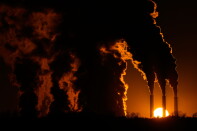 The U.S. is the only major economy where planet-warming pollution dramatically increased last year. The United Nations warns the planet is on track for catastrophic warming.


That prompted Sarah Harris, the Trump administration's acting solicitor general, to ask the U.S. Court of Appeals for the District of Columbia, to block Judge Ali's order. But the appeals court quickly refused to intervene, citing a lack or jurisdiction over temporary restraining orders, which last only short time.
Sponsored message
By then, it was just after 8 p.m. Wednesday, and with the deadline for compliance just four hours away, the administration appealed to Chief Justice John Roberts in his capacity as the justice with supervision over the D.C. Circuit Court. Roughly an hour later, Roberts kicked the can down the road, issuing what is known as an "administrative stay" to allow more time for briefs to be filed. While press reports framed the action as something of a win for Trump, the chief justice may well have decided he too needed a little more time, and that the full court should deal with the matter. What's more, he knew that the justices were meeting for their Friday conference just two days later, meaning that they could sort things out there.
Finally on Tuesday,the court issued its order, siding with Judge Ali. That means that at least for now, the government will have to honor at least part of its financial obligations. It is unclear whether the court will ultimately compel the government to spend all the money that Congress has appropriated.
While the court's order is only the first of what promises to be a series of lengthy legal dramas, the argument in this case boiled down to this: The Trump administration argued that the lower court order's deadline, giving mere days for the government to comply, was not feasible. Moreover, the abrupt Feb. 25 order had "thrown what should be an orderly review by the government into chaos" because it did not provide the government sufficient time to discern which payment obligations are "legitimate." The administration also suggested that the lower court had ventured outside the bounds of its constitutional authority.
The AIDS Vaccine Advocacy Coalition countered that the emergency the Trump administration complained of was "an emergency of its own making." The Coalition noted that the government was initially ordered to resume this funding two weeks ago, but took no steps to comply with that order. Only after the temporary restraining order had almost run its course did Judge Ali issue his Feb. 25 "minute order" to force the government to comply. Finally, the Coalition maintained that the government was merely being asked to return to the "status quo" by honoring its existing contracts.
Copyright 2025 NPR

Senior Vice President News, Editor in Chief


