




One year ago, Congress defunded public media. Now that we're 100% community funded, please become a sustaining member or increase your existing membership today.
Inside a new Iranian bakery in Miracle Mile, ahead of Iran's next match


Sahar Shomali, owner of Kouzeh, stands beside a poster for barbari, the Tehran-style flatbread that inspired her to open the Mid-Wilshire bakery.
(
Gab Chabrán
/
LAist
)
For the Iranian diaspora in Los Angeles, the feelings around Iran's World Cup participation have been complicated. Monday's game between Iran and New Zealand ended in a 2-2 draw at SoFi Stadium. Now, Iran prepares to face Belgium at the same stadium on Sunday in a match that continues to carry weight well beyond the scoreline.
For Sahar Shomali, who owns Kouzeh, an Iranian bakery located in the Miracle Mile neighborhood, those feelings live somewhere between the oven and the morning news.
Kouzeh takes its name from the Farsi word for a clay jar. A small row of them sits on the bakery case that greets customers when they walk in. On the wall above, a laminated National Geographic map of Iran hangs alongside a small illustration featuring an Iranian saying: "What comes out of the vessel is whatever's inside it."
-
 “This is me on a plate” says the SoCal pop-up chef.
 -
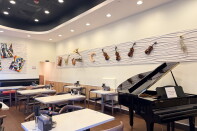 A pair of former piano teachers offers Lanzhou beef noodles and classical music at Chopin Noodle House.
 -
 The property owner has floated preliminary plans to replace Mel’s Drive-In with apartments. Preservationists want it landmarked.


Sahar Shomali didn't plan for the name and the saying to connect. She just liked the way Kouzeh sounded.
Barbari is one of Iran's most beloved breads — a long, oval flatbread with a golden, slightly crisp crust and a soft, chewy interior. It’s as common in Tehran as a baguette is in Paris. And for Shomali, it was the one thing she couldn't stop thinking about after she left and arrived in the U.S.

A selection of breads at Kouzeh, including barbari (far left), kelaneh (the folded triangle), and several sweet breads tied to specific Iranian provinces.
(
Gab Chabrán
/
LAist
)
Sponsored message
Growing up, she lived a 10-minute walk from a barbari bakery, and her father would go every morning before breakfast, coming home with two pieces still hot from the oven. There is a running understanding among Iranians, she said, that you never make it home with the bread whole. Someone always tears off a piece on the walk back.

Kouzeh, an Iranian bakery on Wilshire Boulevard in Mid-Wilshire, opened earlier this year.
(
Gab Chabrán
/
LAist
)
"I really missed that," she said. "Especially the barbari. That was my thing."
When she got to Los Angeles, she went looking for a replacement— and found Persian bakeries making barbari that were, to her, not the real thing. So she did what she calls the opposite: went to culinary school, and spent years moving as far from Iranian cuisine as possible, taking every Californian and French restaurant job she could find.
"So that I could just learn everything that I didn't know," she said.
It worked. In 2018 she left her last pastry chef job and applied everything she'd learned to make barbari. Once she felt she’d cracked it, Kouzeh followed.
Shomali doesn't just stick to barbari. She offers 25 very different breads, some sweet, some savory, each tied to a specific Iranian province. Standouts include kelaneh, a savory Kurdish flatbread with an herb filling — scallion, parsley, cilantro — pillowy soft with a slight char, somewhere between a flour tortilla and a scallion pancake. The kakouli bakhtiyari, made with grape molasses and flavored with fennel and fenugreek seeds, walks the line between sweet and savory. And eashly koukah, a festive bread from Tabriz filled with ginger and turmeric paste, rounds out a case that spans nearly the full breadth of the country.
Sponsored message

The bakery case at Kouzeh, where each bread and pastry is labeled with its city or province of origin.
(
Gab Chabrán
/
LAist
)
None of the breads come from family recipes — Shomali built each one through research, conversations with friends, a single bread book her cousin sent from Iran, and a culinary background that lets her reverse-engineer a recipe from a description alone. The shelves lining the walls tell a similar story: Saba Jams, small-batch preserves made by a childhood friend now based in San Francisco; torshi from Nicole's Kitchen; goods from ZoZo Baking — all Iranian women food makers in California that Shomali sought out personally.
"I called them all up," she said. "I said, I have shelves, and I want Persian goods on those shelves."
While having little interest in sports or the World Cup, Shomali's heart lies with her home country. Every morning, before the bread goes in, she checks the news from Iran — a ritual her customers share.

Even mid-rush, Sahar Shomali makes time for the regulars who keep coming back.
(
Gab Chabrán
/
LAist
)
"We stress about it together, we grieve about it together. But people still show up and buy bread."
It's not lost on her, the duality of how she and her community feel torn between the country they adopted and the one they came from.
Sponsored message
"Both of my countries are at war," she said. "I can't take sides in either one."

Senior Vice President News, Editor in Chief


