




One year ago, Congress defunded public media. Now that we're 100% community funded, please become a sustaining member or increase your existing membership today.
Despite public records requests and a lawsuit, LAPD still hasn’t released crime map data


LAPD Headquarters in front of City Hall.
(
Chava Sanchez
/
LAist
)
In a step backward for transparency, the Los Angeles Police Department has delayed its release of previously-available crime data for more than a year.
Multiple organizations have requested the data after the LAPD stopped regularly releasing the detailed location of most L.A. crimes and the department’s online crime map quietly went dark in early 2025.
Court records and email correspondence shared with LAist show that SpotCrime, a crime mapping and alert provider, filed one of the first public records requests for the unpublished data in February 2025. LAist and nonprofit research organization RAND also submitted separate requests in the following months.
None of the organizations have received that data, despite public records requests and a lawsuit filed by SpotCrime asking a court to order its release.
According to court documents, SpotCrime alleges the LAPD has wrongfully withheld the crime data and engaged in an “unlawful pattern of delaying tactics” to prevent the release of public records.
LAPD still does not have a date for when the data would be made public, according to department spokesperson Norma Eisenman, who declined to comment on pending litigation. Court documents show the department has denied all claims of wrongdoing.
-
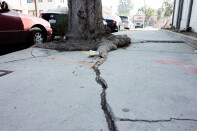 The mediation comes in the city’s 10th year of a 30-year settlement agreement over a class-action lawsuit brought by people with disabilities.
 -
 L.A. County District Attorney Nathan Hochman says more needs to be done to remove a drug market operating in the park after months of enforcement operations.
 -
 A city official not authorized to speak on the record said the plan includes widening the road.


Sponsored message
Why the records matter
The LAPD changed how it reports crime data on the city’s open data portal in early 2025 to no longer include location information down to the city block where crimes were reported.
Roland Neil from RAND said this kind of block-level data is very important for criminal justice researchers.
“ One thing, which is a major focus of the discipline of criminology over the past two decades, especially, is the fact that most crime tends to concentrate in a very small part of the city," Neil said.
He said that just 5% of what researchers call “micro places” — like city blocks or intersections — can account for half a city’s crime. Neil said that makes the block-level data critical when it comes to understanding exactly where crime is happening and determining what could be done to intervene.
The LAPD stopped providing this block-level data when it transitioned to the federally-mandated National Incident-Based Reporting System, or NIBRS.
Sponsored message
Neil said local law enforcement agencies across California saw disruptions over the past few years as they each moved over to the new system, but some police departments were able to keep providing regular, detailed location data as they did before the switch.
San Francisco transitioned to the new system at about the same time as L.A., Neil said, and he can now search that city’s public website for information on crimes that happened just the day before with location data down to the nearest street intersection.
Meanwhile, RAND is still waiting for the LAPD to release its block-level data from months prior.
Jason Ward, director of the RAND Housing Center, told LAist he filed a records request for those records last October.
“They’re not saying no,” Ward said, “they’re just taking a very long time.”
Ward said he understands that the LAPD has limited resources to work on records requests, but he questions why the department would risk being seen as less transparent by allowing a delay in the release of information that used to be readily available.
He said he just wants the LAPD to continue providing what they had already been releasing for years: “accurate, geolocated crime data.”
Sponsored message
This data isn’t just important for researchers.
Paul Nicholas Boylan is an attorney representing SpotCrime in the company’s lawsuit against the LAPD. He told LAist there are few things he believes to be as important to the public interest as crime data.
“It allows the public to decide whether they live in a safe space,” he said. “It allows them to determine whether or not law enforcement is doing a good or bad job.”
How to reach me
If you have a tip, you can reach me on Signal. My username is jrynning.56.
- You can follow this link to reach me there or type my username in the search bar after starting a new chat.
- For instructions on getting started with Signal, see the app's support page.
- And if you're comfortable just reaching out by email I'm at jrynning@scpr.org
Why LAPD says the data hasn’t been released
Boylan said he has practiced First Amendment law for decades, but has never seen another case where an agency has taken so long to release public data without providing substantial justification for the delay.
The LAPD told SpotCrime in August that the records were unavailable, according to court documents and email correspondence reviewed by LAist — but not because the department didn’t have them.
Sponsored message
“The data is not user-ready simply because that the raw data needs additional processing,” the department wrote to SpotCrime. The LAPD message also said the data would be published on the open data portal “as soon as practical.”
Seven months later, the data has not been released and Boylan is skeptical of the department’s argument.
Other agencies like the L.A. County Sheriff’s Department made the same transition to NIBRS, he said, but no other agency has taken as long to solve this problem.
He said there could be legitimate reasons any additional data processing has taken more than a year, but that it could also be due to incompetence or an attempt to hide information that could reflect poorly on the department.
SpotCrime has also argued that they never requested “user-ready” data, according to court records and emails reviewed by LAist. The company told the LAPD their request was for raw data, and additional processing they did not ask for was “not a valid reason for denying access.”
LAist was given a different explanation for why the records could not immediately be released.
The department initially denied LAist’s May 2025 request for detailed crime data in October, claiming the data in its raw form is exempt from disclosure because it “has the potential to lead to misguided public policy discussions or unjustified public panic.”
David Loy, legal director for the First Amendment Coalition, told LAist at the time that he had never heard of such an argument. He said if taken seriously, it would “destroy” the entire California Public Records Act.
The LAPD has not directly responded to LAist’s request for clarification on the claim that the data is exempt for such a reason, but appears to have abandoned the argument. The department told LAist on March 11 that “the Department continues to repair, sanitize, and review” crime and arrest data that may be released.
Boylan said he expects more answers to come out in court.
Whatever the LAPD claims is the reason for the delay, he said, “they're going to have to prove it.”
Updated March 18, 2026 at 1:36 PM PDT
This story has been updated to include a comment from LAPD.

Senior Vice President News, Editor in Chief


