




One year ago, Congress defunded public media. Now that we're 100% community funded, please become a sustaining member or increase your existing membership today.
'A sigh of relief': LA reacts to Supreme Court decision on birthright citizenship


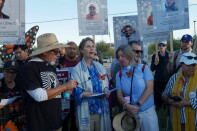
Advocates gathered at the headquarters of the Coalition for Humane Immigrant Rights following the Supreme Court's decision to uphold birthright citizenship.
(
Julia Barajas
/
LAist
)
A wave of relief moved through L.A. communities on Tuesday after the U.S. Supreme Court upheld birthright citizenship.
The 6-3 decision to affirm the nation’s 158-year-old legal standard also rejected an executive order signed by President Donald Trump on Jan. 20, 2025, moments after his inauguration. Legal scholars underscore that Justice Brett Kavanaugh agreed with the majority's decision, but based his reasoning on a federal statute instead of the U.S. Constitution.
Had the Supreme Court upheld the executive order, citizenship for anyone born in the U.S. would have depended on their parents’ nationality and residence history.
Solicitor General D. John Sauer, who argued on behalf of the Trump administration, said the nation’s longstanding practice has incentivized foreigners to travel to the U.S. to have babies — including some from “hostile nations.”
-
 The National Day Laborer Organizing Network is offering courses for workers in a variety of industries, in English and Spanish.
 -
 Faith leaders and families made the trek on foot during a blistering heat wave from the Adelanto ICE Processing Center in the Mojave Desert.
 -
 Hedy Torres started the portraits during the first Trump administration, vowing to complete them when her subjects attained lawful permanent residency.


“ For more than a century and a half, our laws have reaffirmed that fundamental right. Today's ruling is a long overdue message to Donald Trump: No president can pretend to erase a bedrock constitutional guarantee with the flick of a pen,” said Alvaro Huerta, director of litigation and advocacy at Immigrant Defenders Law Center.
“We're relieved that the Supreme Court firmly rejected the Trump administration's overreach and reaffirmed what frankly should never have been in question,” he added. “ Today, we can breathe a sigh of relief.”
Sponsored message
Angelenos respond to SCOTUS
In Los Angeles, the Coalition for Humane Immigrant Rights spoke to reporters at its headquarters, inviting fellow advocates and local residents of all ages to celebrate the majority opinion.
“ The decision today carries profound meaning for all of us,” said Dahni Tsuboi, CEO of Asian Americans Advancing Justice-Southern California, which was among dozens of advocate groups that filed a brief in support of immigrant families.
“More than 60%of Asian Americans in this nation were born somewhere else. So for us, immigration is not a policy debate . . . It is our story of how we came here, how we created home here, how our children's dreams took shape,” she said.
“ The Trump administration tried to challenge the 14th Amendment, which initially guaranteed birthright citizenship in the aftermath of slavery, ensuring that formerly enslaved Black people and their descendants could not be denied membership in the nation that they built,” added Maraky Alemseged, an organizer with the Black Alliance for Just Immigration.
The Supreme Court’s ruling on birthright citizenship, they noted, comes on the heels of its decision to allow the Trump administration to cancel temporary protected status for Haitians and other groups, without being subject to review in federal courts. The administration has also moved to cancel naturalization ceremonies for people who hail from countries it’s deemed to be “high-risk.”
In response, Alemseged called for continued advocacy and “a broader vision of belonging, one where humanity is not contingent on [immigrant] status.”
Sponsored message
Why it matters
Cecilia Wang, national legal director of the ACLU, represented families who could have been affected. The nonprofit sued the Trump administration almost immediately after the president signed the executive order.
When speaking before the Supreme Court in April, Wang — herself a birthright citizen — pointed to some of the darkest moments in U.S. history to bolster her argument.
“ Even in World War II, when the United States was detaining Japanese nationals who were deemed ‘enemy aliens’ of the United States, when those ‘enemy aliens’ had babies in these detention camps, everyone agreed that those babies were U.S. citizens,” she said.
Wang also cited United States v. Wong Kim Ark, a landmark case involving a Chinese American man from California. In that 1898 case, Wang noted, the court ruled that the Fourteenth Amendment guarantees citizenship to almost anyone born in the country, regardless of their parents' nationality or immigration status.
In 2023, birthing people who were undocumented immigrants or who had legal temporary status had 320,000 babies, representing about 9% of all the 3.6 million children born in the U.S. that year. According to the Pew Research Center, about 260,000 of those babies would not have qualified for birthright citizenship if Trump’s executive order had already been in effect.
Immigrant advocates feared such children would become part of a permanent underclass. The United Nations has signaled that when people are rendered stateless, they can encounter a host of challenges — everything from barriers accessing education and healthcare to the inability to travel freely. Arguing on behalf of the Trump administration, Sauer dismissed those concerns as alarmist “ end-of-the-world type predictions.”
Updated July 14, 2026 at 12:09 PM PDT
This article has been updated to reflect the nuance behind the majority's decision.

Senior Vice President News, Editor in Chief


