




One year ago, Congress defunded public media. Now that we're 100% community funded, please become a sustaining member or increase your existing membership today.
How to decode those political mailers clogging up your mailbox


Students in a Fullerton College class evaluate political mailers.
(
Jill Replogle
)
A political science class at Fullerton College is sorting through campaign mailers to learn how to decode attack ads and who pays for them, and to understand how candidates try to sway voters. There are some lessons for the rest of us, too.
The assignment
In Jodi Balma's political science class recently, students broke into groups with piles of mailers sent out in the 45th Congressional district, where incumbent Republican Michelle Steel is facing off against Democrat Derek Tran. Students tallied up the negative and positive ads, analyzed the colors and messaging, and noted who paid for them.
-
 A skate for Dolly Parton, Charlatans UK at the Palladium, all of the Lord of the Rings movies and more of the best things to do this week.
 -
 The district’s kitchens are moving away from individually-wrapped lunches to freshly cooked dishes in an effort to boost nutrition and reflect their community diets.
 -
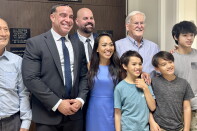 Councilwoman Amy Phan West was cleared of a misdemeanor charge, but still faces a city lawsuit and an election battle.


What's the point?
Balma said learning how to "diagnose" campaign ads is a skill students can take throughout their voting life.
"When you actually critically look at it in a classroom, you get a very different perspective than when it's in your mailbox," Balma said. "And so teaching that skill stays with the students forever."
Sponsored message
A few tips about campaign mailers:
- Generally, political ads have to disclose who paid for them. California's Fair Political Practices Committee (FPPC) has a handy fact sheet that lays out the basic rules.
- If you think an ad violates the rules, you can upload a photo of it or send a link to the FPPC's enforcement division and they'll review it.
- Voting early can help slow the flood of campaign ads to your mailbox. Sophisticated campaigns tailor their mailers to people they think they can sway.
Still working your way through the ballot? Head over to LAist.com/Vote for a guide to help you fill out your ballot.
We don't do endorsements. But we do help you break down the races, measures and issues that impact you most of all.
What questions do you have about this election?
You ask, and we'll answer: Whether it's about how to interpret the results or track your ballot, we're here to help you understand the 2024 general election on Nov. 5.
Trending on LAist
-
 A lottery will be held in October to decide who the units will be offered to.
 -
 An LAist investigation found officials awarded millions to a homeless services group even after it was flagged for failing to do its job. Its leader pleaded not guilty.
 -
 LAist wants to help you make sense of El Niño, the climate pattern that can cause dangerously wet winters in Southern California.
 -
 US set for largest mass visa revocation in history targeting up to 200,000 foreigners, officials sayIf it happens, the move would be the largest single mass revocation of visas in U.S. history and would likely face legal challenges.
 -
 This is likely to be the hottest heat wave of the year — so far. Warnings from the National Weather Service are in effect from Tuesday morning through Friday evening.
 -
 The new rules for defensible space around homes are some of the strictest in the country, but firefighters and others stress their importance.


Best of LAist


