




One year ago, Congress defunded public media. Now that we're 100% community funded, please become a sustaining member or increase your existing membership today.
LA’s program that diverts mental health crisis calls away from police to expand

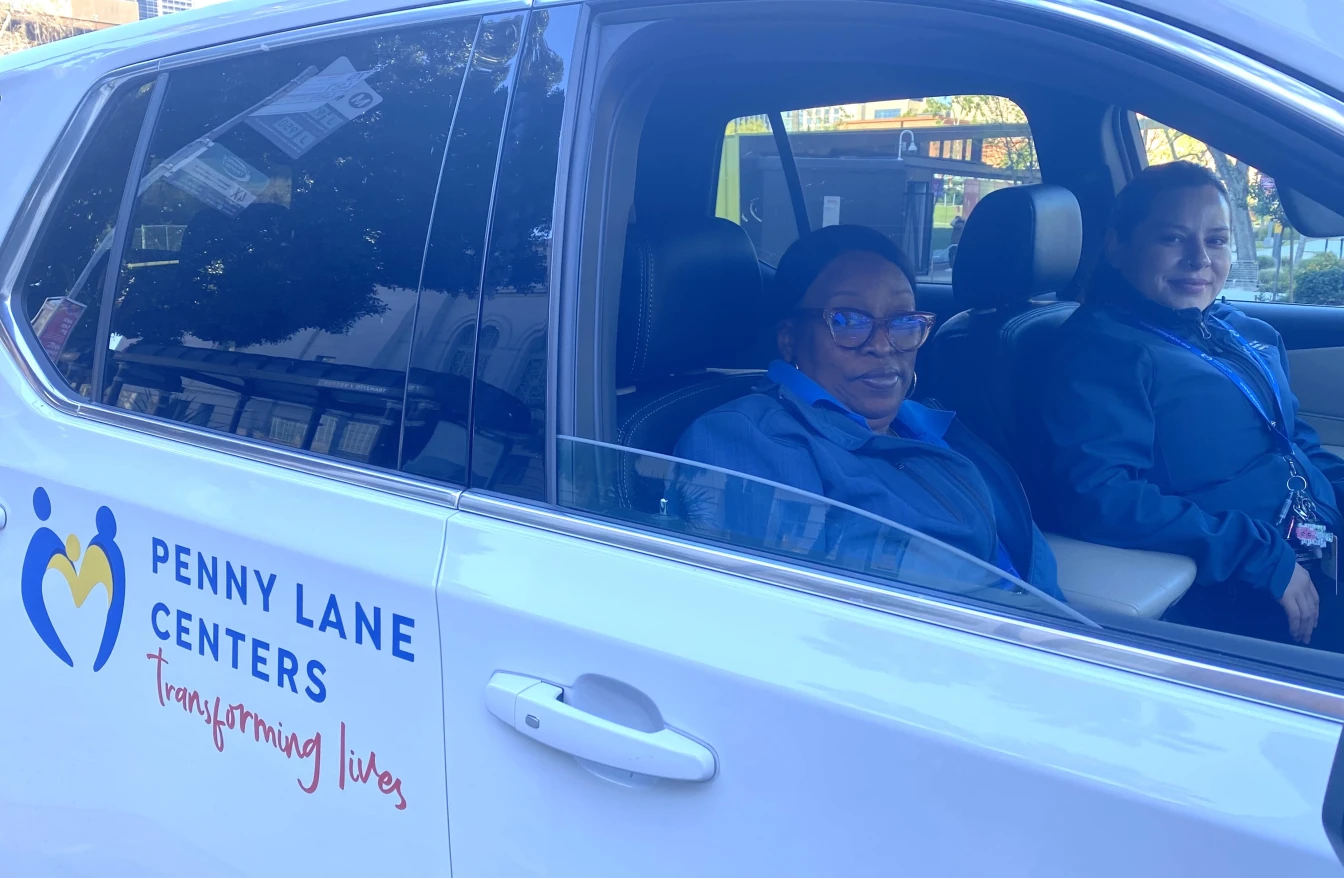
Crisis workers Alice Barber (L) and Katie Ortiz (R) sit in a Penny Lane Centers crisis response vehicle
(
Robert Garrova
/
LAist
)
The Los Angeles City Council’s recently approved budget includes funding to expand a program that diverts police from some mental health crisis calls to 911.
Since launching in 2024, trained clinicians with the city’s Unarmed Model of Crisis Response (UMCR) have handled over 20,000 calls ranging from mental health crises to wellbeing checks. About 96% of those calls were resolved without police or a response from the L.A. Fire Department.
The new city budget includes funding to expand those teams from nine police divisions — including Devonshire, Wilshire, Southeast, West L.A., Olympic and West Valley — to a total of 15.
“In a year where many programs continue to fight for service funding from the city, it’s so great that we are able to continue prioritizing this,” Godfrey Plata, deputy director of progressive policy advocacy group the LA Forward Institute, told LAist.
Plata said UMCR’s expansion is one more step toward taking the program citywide, which his group hopes to do by the 2028 Olympics.
The crisis teams are slated to go online within the six additional police divisions by June 2027. It’s not yet clear which police divisions will be selected for expansion.
The move comes after the City Council voted unanimously in February to make the pilot program permanent.
Sponsored message
A 2024 LAist investigation found that nearly one-third of LAPD shootings since 2017 involved someone living with a mental illness and/or experiencing a mental health crisis.
How the program works
In 2024, the city partnered with three nonprofit organizations — Exodus Recovery, Alcott Center and Penny Lane Centers — to provide teams of trained clinicians in service areas spread across L.A. The teams are available 24 hours a day, seven days a week within the Police Department’s Devonshire, Wilshire, Southeast, West L.A., Olympic and West Valley divisions.
Crisis response workers are trained in de-escalation techniques, mental health, substance use, conflict resolution and more, according to a report from the Office of City Administrative Officer. The teams don’t have the authority to order psychiatric holds for people in crisis, but they can work with them to find help locally, and spend more time on follow up than law enforcement can.
In its first year, Los Angeles’s Unarmed Model of Crisis Response sent teams of unarmed clinicians to more than 6,700 calls for service, ranging from mental health crises to wellbeing checks. About 4% were redirected to the LAPD. Average response times have been under 30 minutes.
Examples of these interactions include members of the teams taking food to a woman who was crying and hungry, working with a business owner to engage with someone sleeping in a parking lot and sitting with a family for nearly three hours to help resolve a conflict involving a relative.
Support from LAFD
During an L.A. City budget hearing last month, fire officials expressed support for the Unarmed Model of Crisis Response.
Sponsored message
The department said it’s worked with the teams of clinicians to divert calls for service away from fire first responders since September 2025. The department saw 144 calls diverted to UMCR in the month of March alone.
“We’ve found them to be an incredible asset and ally to addressing some of the issues in the field,” LAFD Chief Jaime Moore told council members at the hearing. “The recommendation would be to expand the program, get it into more police divisions which would then get it into more of our battalions and our bureaus."
What’s next
City officials have expressed support for expanding UMCR citywide by the 2028 Olympics.
With the plan to expand to 15 police divisions by June 2027, UMCR would need to expand into another six divisions to meet that goal.

Senior Vice President News, Editor in Chief


