




One year ago, Congress defunded public media. Now that we're 100% community funded, please become a sustaining member or increase your existing membership today.
LA’s program that diverts mental health crisis calls away from police becomes permanent

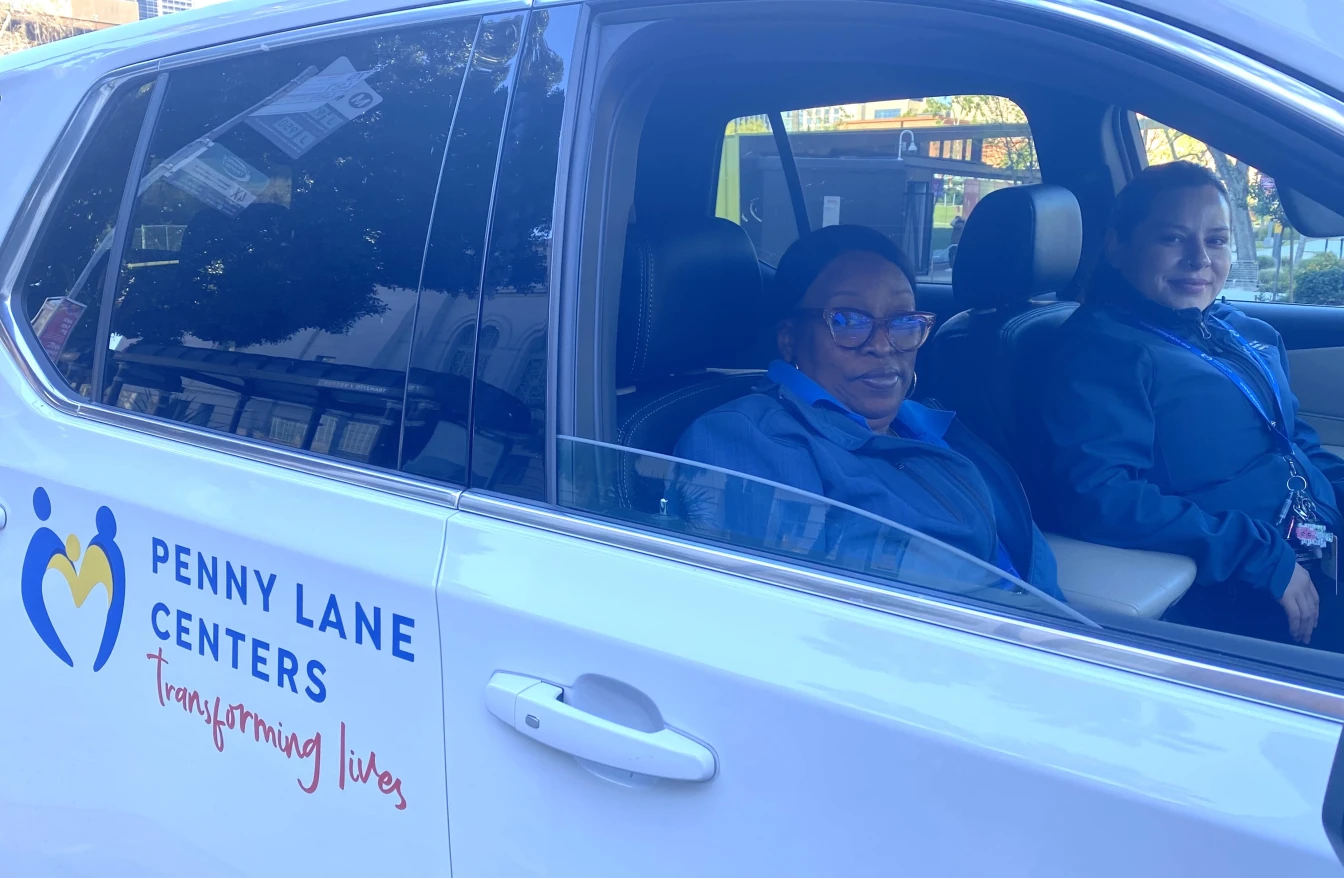
Crisis workers Alice Barber (L) and Katie Ortiz (R) sit in a Penny Lane Centers crisis response vehicle
(
Robert Garrova
/
LAist
)
The L.A. City Council voted unanimously Tuesday to make permanent a city pilot program that diverts police away from some mental health crisis calls.
Since launching in 2024, clinicians with the city’s Unarmed Model of Crisis Response have handled more than 17,000 calls for service, ranging from mental health crises to wellbeing checks. According to city reports, about 96% of those calls were resolved without police.
“We can’t keep deploying armed officers to handle mental health crisis calls because the outcome is Angelenos paying with loss of life and millions of their tax dollars for legal settlements,” Councilmember Eunisses Hernandez, who co-authored the motion to enshrine the program, said at Tuesday’s meeting.
According to Hernandez, in 2023, more than a third of LAPD shootings involved someone experiencing a mental health crisis.
Councilmember Marqueece Harris-Dawson said the data from city reports was "incontrovertible and unassailable," showing the program’s success at diverting police and fire first responders away from mental health crisis situations.
Council members said the move to make the unarmed model permanent was also a matter of fiscal responsibility. According to a news release from the offices of Hernandez and Councilmember Bob Blumenfield, on average it costs the city roughly $85 per hour to dispatch LAPD officers, while a response from a UMCR team costs roughly $35 per hour.
Last fall, progressive policy advocacy group LA Forward, convened a summit of local and state officials with the goal of making UMCR permanent and expanding it.
Sponsored message
Godfrey Plata, deputy director of LA Forward, told LAist his group was “incredibly excited” to see the city make the pilot program permanent.
Plata said he sees enshrining the program as a first step in expanding the program citywide, which his group hopes to do by the 2028 Olympics.
How the program works
In 2024, the city partnered with three nonprofit organizations — Exodus Recovery, Alcott Center and Penny Lane Centers — to provide teams of trained clinicians in service areas spread across L.A. The teams are available 24 hours a day, seven days a week within the Police Department’s Devonshire, Wilshire, Southeast, West LA, Olympic and West Valley divisions.
Crisis response workers are trained in de-escalation techniques, mental health, substance use, conflict resolution and more, according to a report on the program from the Office of City Administrative Officer. The teams don’t have the authority to order psychiatric holds for people in crisis, but they can work with them to find help locally, and spend more time on follow up than law enforcement can.
In its first year, Los Angeles’s Unarmed Model of Crisis Response sent teams of unarmed clinicians to more than 6,700 calls for service, ranging from mental health crises to wellbeing checks. Only about 4% were redirected to the LAPD. Average response times have been under 30 minutes.
Examples of these interactions include members of the teams taking food to a woman who was crying and hungry, working with a business owner to engage with someone sleeping in a parking lot and sitting with a family for nearly three hours to help resolve a conflict involving a relative.
Sponsored message
What’s next
The motion approved Tuesday also directs city officials to form a working group made up of the LAPD, the L.A. Fire Department and other agencies to address inefficiencies in the dispatch system. The goal of the working group will be to centralize unarmed crisis response dispatch and improve response times.

Senior Vice President News, Editor in Chief


