




One year ago, Congress defunded public media. Now that we're 100% community funded, please become a sustaining member or increase your existing membership today.
Can Disneyland's Napa Rose earn a Michelin star?


Napa Rose reopened Feb. 6 after a 10-month renovation.
(
Ron De Angelis
/
Courtesy Disneyland Resort
)
If you're looking for fine dining, Disneyland may not come immediately to mind. But you'd be wrong.
Twenty-five years ago, Disneyland opened its first high end restaurant, Napa Rose, inside the Grand Californian Hotel. Its chef, Andrew Sutton, had been plucked from Napa Valley, and it went on to build a reputation as one of the most ambitious dining destinations in Orange County. (Sutton is now the culinary director of all of Disney's top-tier dining in Anaheim — including the members-only Club 33 and Carthay Circle.)
But after more than two decades, the restaurant had started to show its age — the Wine Country identity was baked into the bones of the room, but the cuisine and plating style felt more Y2K than TikTok.
So last April, Napa Rose closed for extensive renovations. Almost a year later, it's now reopened with a new tasting menu, a reimagined dining room and expanded bar and lounge, under a new Executive Chef, Clint Chin.
-
 LAist sat down with the general manager of Keno's Restaurant in Anaheim Hills, where you can find a 15-pound burrito or a 32-ounce Tomahawk steak.
 -
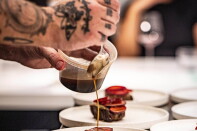 Darkroom trades curb appeal for creative freedom — and locals can't get enough of what's coming out of the kitchen
 -
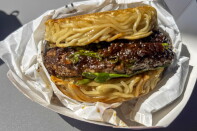 Keizo Shimamoto is serving some of Southern California's best ramen under the radar in Orange County.


Wine Country, by way of Anaheim
At a press dinner, General Manager Jess Soman was candid about his ambitions: he wants Napa Rose to earn a Michelin star. It's not such a far-fetched idea — he helped The Inn at Little Washington in Virginia earn three Michelin stars.
Sponsored message

The newly redesigned bar and lounge at Napa Rose, where the evening began with passed champagne and remarks from the team behind the reinvention.
(
Ron De Angelis
/
Courtesy Disneyland Resort
)
But another remark from the evening struck me just as much: for many guests, Napa Rose is their first fine-dining experience. That's a meaningful thing — the first time a sommelier explains a pairing without condescension, the first time a tasting menu tells you a story. If that's the role Napa Rose wants to play, then what ends up on the plate matters even more.
The dining room is beautiful, anchored by a chandelier that resembles a suspended vineyard — glass orbs hanging from sculpted grapevine forms — glowing softly over carved murals of wine-country harvest scenes. The walls are lined with 3,800 bottles in climate-controlled cabinets. It feels warm and intimate.
It's also, inescapably, inside a theme park resort. Somewhere beyond these walls, people are screaming on Radiator Springs while wearing a $55 popcorn bucket that lights up. All the staff were also wearing Disney name tags. That tension — between genuine culinary ambition and the Disney universe that contains it — is something I kept turning over in my head all night.
$188, four courses, one question
The tasting menu costs $188 for four courses, including an amuse-bouche and dessert.
The first course was grilled fish served with lobster toast and a lemon bubble foam. Everything tasted fine together, but it was forgettable, the kind of dish that disappears from memory before the wine glass is refilled.
Sponsored message

Thinly sliced American Wagyu beef rolled over roasted red and gold beets with grape mostarda and green pea purée
(
Ron DeAngelis
/
Courtesy Disneyland Resort
)
The American Wagyu N.Y. was a different story. Thinly sliced and rolled, resembling a fancy cut of pastrami, the beef's richness played well against the familiar, comforting roasted beets, and the grape mostarda added just enough sharpness. I noticed the plating too — more restrained than before, with dots of pea purée placed deliberately and real negative space on the plate. If this is what the new Napa Rose looks like, the kitchen has at least shed its previous aesthetic.
Then came the sorpresine pasta with California crab broth and Pacific uni, and the evening stumbled. The sauce was watery and thin, the uni flavor barely there, the crab scarce — a few pieces struggling to justify the menu's promise. At $188 a head, I felt shortchanged. But the detail I couldn't shake was the bowl: a sea urchin-shaped vessel coated in dark black ceramic that, when scraped with the silver fork, produced a sound like nails on a chalkboard. At a restaurant that spent eight months and untold millions on a reinvention, the thing I remember most vividly from the third course is a noise.

The sorpresine pasta with California crab broth and Pacific uni. The bowl looked striking. It sounded less so.
(
Ron DeAngelis
/
Courtesy Disneyland Resort
)
For the entrée, I opted for the swordfish served with ancient grains, black lentils, and hijiki, a Japanese seaweed, whose briny depth complemented the fish.

The sustainable fish with ancient grains, black lentils and hijiki.
(
Ron De Angelis
/
Disneyland Resort
)
The meal concluded with what the menu called an "Elevated and Reminiscent" Valrhona chocolate bar with hazelnut praline. It's a very Disney move: narrate the experience so the guest knows what to feel before they feel it. It did deliver on its promise: lush chocolate with a delicate texture that was indeed reminiscent of a candy bar, in the best possible way. Or perhaps by that point I'd been fully indoctrinated.
Sponsored message

The "Elevated and Reminiscent" Valrhona chocolate bar with hazelnut praline, with the name does the interpretive work for you.
(
Ron De Angelis
/
Courtesy Disneyland Resort
)
Who is this for?
Ultimately, it all felt very competent yet cautious — playing it safe at every turn. Which may be exactly what you need to make a first fine-dining experience extra-special. But a restaurant gunning for a Michelin star needs to do the opposite — to surprise, to unsettle, to serve something a diner has never seen before.
The reinvented Napa Rose seems caught between these two identities, swinging big on paper but playing it safe on the plate. I’m not sure the restaurant knows exactly what story it wants to tell yet. But the fact that it's asking the question might be enough for now.

Senior Vice President News, Editor in Chief


