




One year ago, Congress defunded public media. Now that we're 100% community funded, please become a sustaining member or increase your existing membership today.
Tariffs cost American shoppers. They're unlikely to get that money back

People walk by a shopping mall along the Las Vegas Strip on April 8, 2025.
(
John Locher
/
AP
)
Listen
4:02
Will American shoppers get a tariff refund?
American businesses and shoppers paid the vast majority of the billions of dollars collected for the emergency tariffs that the Supreme Court recently ruled illegal. Companies are now pushing to get their money back. But can shoppers expect their own refund?
Probably not, according to Robert Shapiro, an international trade lawyer and partner at the law firm Thompson Coburn.
"And if you do, it'll be pennies on the dollar," Shapiro said.
The roughly $180 billion collected under the struck-down tariffs, according to an estimate by Goldman Sachs, was typically paid for directly by businesses, and indirectly by consumers through higher prices. Because those companies often paid the actual customs bill, any refund from the federal government would go to them.
Shoppers will have to wait for companies to get their refunds before any potential reimbursements might trickle down to them. And that could take a while. President Donald Trump suggested the question of whether the government has to refund those tariffs could be tied up in lawsuits.
"I guess it has to get litigated over for the next two years," Trump said during a press conference after the Supreme Court's decision.
Shapiro said when and if those businesses get a refund, some will pass along savings to consumers, but others will not. "They'll just take it as a gain," he said.
Sponsored message
-
 The opening of the long-awaited LAX People Mover train is getting pushed back, again.
 -
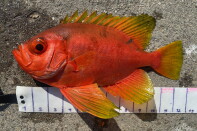 The creatures are here because of warm waters associated with El Niño, but the climate system could also threaten native species that aren’t used to the heat.
 -
 Federal changes starting in 2027 could impact 1 million L.A. County enrollees.


Several Democratic political leaders have pushed for a more direct resolution: Simply have the government send checks to Americans. Illinois Gov. JB Pritzker sent a letter and invoice to Trump demanding that he refund every Illinois family $1,700. California Gov. Gavin Newsom also called on Trump to send out checks.
But there's a logistical issue: The tariff revenue isn't held in its own special account. When collected, it goes into the country's general fund. The U.S. Treasury could send out checks, but companies would still have a claim on their refunds. In that scenario, tariff refunds could be counted twice between customers and companies, drastically increasing the cost to the federal government.
There's another possibility, if companies are slow to pass their refunds along: Shoppers could launch class action lawsuits aimed at forcing companies to offer refunds for tariff surcharges.
Still, that poses a similar accounting challenge. For many products, the tariffed costs often weren't shared by one company and one customer, but across a supply chain. Think of products made of many materials — like a bike or a coffee maker — with parts made by different suppliers, which all contributed to tariff fees. Even a product as simple as a store-shelf-ready stuffed animal shipped from China can pass through multiple hands, from the importer to the wholesaler to the retailer, and finally on to the shopper.
How would the shopper prove what portion of the tariffs they paid and how much they deserved to get back?
"Tracing that through — it may be literally impossible," said Michael Ettlinger, a senior fellow at the Institute on Taxation and Economic Policy.
Sponsored message
But managing refunds could be easier for companies that put their tariff fees right on the receipt.
Erin Vandenberg is a frequent shopper with the athletic wear company Fabletics; she pays $70 a month for a membership and gets back credits to spend on outfits, like vests and fleece-lined leggings. Last year, she noticed a tariff surcharge on items, like $3.95 on top of a $69.95 berry-colored sports bra.
"They're making it very obvious what's happening," Vandenberg said. But she also found it discouraging. She recalls thinking, "Oh, well gosh! Maybe I don't want to buy this."
For her most recent order, before discounts and her credits, the value of the clothes totaled up to about $520, including $30 from tariff costs.
Since she had already paid for the membership credits, she went ahead with the order anyway.
Fabletics is far from the only company to shift some tariff costs to customers. The company was just the rare business to spell it out.
In a statement emailed to NPR, Fabletics said: "We implemented a clearly labeled tariff surcharge at checkout to be transparent with consumers and ensure we can continue providing the highest-quality products at the most competitive prices. The surcharge only partially covers our cost increases but we felt it was important to not pass the full burden of cost on to our consumers. While the Supreme Court ruling is an important development, tariffs remain in place and there are still many outstanding questions regarding implementation and potential refunds that we are closely monitoring."
Sponsored message
Vandenberg has no idea how much she paid in tariff fees to other businesses. Now that those tariffs are gone and companies are pursuing refunds, Vandenberg would love to get her money back from them. And she would be willing to join a lawsuit to get it.
"At this point, I feel like those are sometimes the only way you can hold businesses, or companies, or the government accountable," Vanderberg said.
Copyright 2026 NPR

Senior Vice President News, Editor in Chief


