




One year ago, Congress defunded public media. Now that we're 100% community funded, please become a sustaining member or increase your existing membership today.
LA County mpox cases are rising. What’s driving the increase?


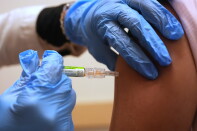
Hundreds of people received the monkeypox vaccine over two days at DTLA Proud.
(
Jackie Fortiér
/
LAist
)
Cases of mpox have doubled in recent weeks, the Los Angeles County Department of Public Health announced on Monday.
Mpox is caused by a virus in the same family as smallpox, though it’s not as transmissible or fatal. It’s spread mainly through close contact, and its symptoms can include a fever, aches, and painful rashes on the face, mouth, hands and even genitals.
Listen
0:51
LA County mpox cases are rising. What’s driving the increase?
Health experts say getting vaccinated and early detection are key to controlling the disease’s spread.
Why the local rise?
The department reported 52 cases in the last four weeks, a jump from 24 in the previous four-week period.
-
 Flu season typically starts in October or November. But it looks like the flu started to pick up in September this year.
 -
 As checks from President Donald Trump for health costs hit millions of mailboxes, a poll shows Americans don't trust Republicans on healthcare.
 -
 Environmental groups are seeking to force the release of public records and data related to the fire, officials’ response and potential health risks to the community.


Sponsored message
Dr. Sonali Kulkarni is the medical director of the department’s division of HIV and STD programs. She said they typically see mpox transmission increase like this with social and sexual activity over the summer.
“This is acting in the United States as a sexually transmitted infection because it’s spread by very close physical and intimate contact,” Kulkarni said. “It was quite concerning at this point to see the cases go up, like, twofold, essentially, in the course of a month.”
Rising cases in other countries could be driving more people to get tested, too.
“We think there’s a little bit of increased attention to mpox because of the news coverage of what’s been going on in Central and Western Africa,” Kulkarni said. “So we did see the testing numbers go up.”
Families of the mpox virus are called “clades.” The U.S. has clade two, which tends to cause less severe disease and is less fatal than clade one, according to the World Health Organization. Africa’s spread is from clade one.
“There’s no current cases [of that] in the United States, but we remain vigilant,” she said.
Most cases are unvaccinated
More than two thirds of the cases in the last six months have occurred in people who were unvaccinated.
Sponsored message
“We just don’t have enough immunity in the community to really stop this from continuing to spread,” Kulkarni said.
How to find a vaccine
Your primary care doctor can get you vaccinated if you have one. L.A. County health clinics also offer the two-dose vaccine for free. Keep in mind, it takes about six weeks to become fully vaccinated and protected. You can find a public health clinic here.
Since the mpox vaccine requires two doses, she’s also concerned that people who have only had one dose aren’t fully protected, and wants them to finish the cycle.
She said just like other vaccines, the mpox one is not perfect and breakthrough cases can happen. However, it does prevent many people from getting it, and those who do, get a milder form of mpox.
That’s why the department is urging at-risk groups to get both mpox shots, which can be free.
Who’s most at risk?
Anyone can get mpox because this is a virus that spreads between people, but certain groups are more at risk. Those groups include:
- Men who have sex with men
- Transgender or nonbinary people who have sex with men
- Any person who has sex or intimate physical contact with others at a large public event or engage in commercial and/or transactional sex
- Persons living with HIV
- Sexual partners of people in any of the above groups
While the transmission of mpox is still considered low in the U.S., public health officials want people to take steps to protect themselves. Kulkarni said L.A. County has more mpox than the department has seen in the last 20 months.
Sponsored message
She said they’ve learned from the COVID-19 pandemic that everyone has different risk thresholds. Steps people can take if they want to reduce their risk include reducing the number of sexual partners, and using condoms.
“I think for folks who are in populations that are at risk for mpox, I think that this trend that we’re seeing, we wanted folks to know about it because it may bring pause to everyone,” Kulkarni said.

Senior Vice President News, Editor in Chief


