




One year ago, Congress defunded public media. Now that we're 100% community funded, please become a sustaining member or increase your existing membership today.
The Arts District restaurant making Japanese food you've never tasted before


The uni kiritampo, Bengara's take on a traditional Akita prefecture rice skewer, finished with uni and scallion.
(
Wonho Frank Lee
/
Courtesy Bengara
)
When Bengara opened in Los Angeles' Arts District earlier this year, its owner and head chef had something special lined up in their kitchen arsenal.
It was genshiyaki, a rare traditional Japanese grilling method that dates back 1,500 years.
Chef and co-owner Tyler Burges had only encountered it once while traveling in Japan at a robatayaki spot in Fukuoka, a port city on the island of Kyushu.
Robatayaki, a style of slow, ember-cooked grilling rooted in Japan's rural coastal kitchens, usually centers on an open charcoal hearth. But the restaurant Burges visited had something even more noteworthy: a genshiyaki pit, a gentler, ambient method of cooking that uses radiant heat instead of direct flame.
Loving the unusually subtle, delicate flavor and texture it produced, he and head chef Phil Mireles decided to bring genshiyaki back to the U.S. and build their Arts District restaurant around it. The genshiyaki pit is a rare enough technique that Burges had to work with fabricator Phil Roxworthy for six months just to get the grill built to specifications.
It's Burges' and Mireles' first L.A. project. The pair are also behind Smoke Door, their acclaimed Lake Tahoe restaurant, and Bengara brings a more casual, day-to-day take on the same fire-driven cooking.
-
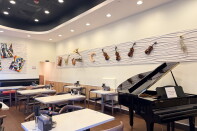 A pair of former piano teachers offers Lanzhou beef noodles and classical music at Chopin Noodle House.
 -
 The property owner has floated preliminary plans to replace Mel’s Drive-In with apartments. Preservationists want it landmarked.
 -
 Try a South Bay crawl that runs from a market stall to a sleek sit-down dining room.


Sponsored message
All roads lead to the Arts District

Chef/owner Tyler Burges (left) and head chef Phil Mireles at Bengara.
(
Wonho Frank Lee
/
Courtesy Bengara
)
Burges and Mireles both got their start at San Francisco's Saison and Angler under chef Joshua Skenes — who's now just down the street in L.A. at LYNX with fellow alum Brandyn Tepper.
Burges traces Bengara's DNA back to two mentors: Ron Siegel, who introduced him to Japanese ingredients and technique in his mid-20s, and Skenes, who taught him to cook with live fire. It was Skenes, Burges said, who showed him that fire didn't have to mean char and bravado.
Support local food coverage
"The one thing I loved about wood-fire cooking is you get this subtle, sweet barbecue flavor when you cook correctly over embers, and you don't cook directly over the fire," Burges said. "Most places, when you think about grilling something, you think of char, bold flavors, masculine flavors. But Chef Josh — it's like a master art, getting really delicate, subtle flavor using that grill method."

The uni kiritampo, Bengara's take on a traditional Akita-prefecture rice skewer, finished with scallion.
(
Wono Frank Lee
/
Courtesy Bengara
)
Sponsored message
What sets the food apart
Take their luscious miso cod. On a normal grill, the marinade's sugars would blacken before the fish cooked through. On the genshiyaki pit, the cod sits at a distance from the embers, cooking gently until the very end, when it's given one last pass directly over the coals — what Burges describes as a final "kiss" of heat before it hits the plate.
To fuel genshiyaki's slower, ambient style, ordinary charcoal or wood is replaced with binchotan, an ultra-dense, pure-carbon hardwood charcoal traditionally made in Japan, which burns hotter and cleaner.
The signature dish
A perfect example of how this cooking style comes together is the uni kiritampo, the Akita prefecture rice skewer, reimagined with uni and cooked via genshiyaki — born of an offhand kitchen conversation with one of the restaurant's Japanese chefs about regional dishes cooked over fire.
Once they realized genshiyaki was the dish's original, historic cooking method, the rest fell into place.
"It's like the most delicious thing," Burges said. "I don't know why it never made it over to the United States earlier."
Sponsored message

Bengara's Arts District dining room pairs industrial bones with warm, low lighting and long communal tables.
(
Wonho Frank Lee
/
Courtesy Bengara
)
The chewy exterior, with just a hint of smoke, gives way to a creamy inside, like a caramelized custard, that’s topped with a decadent amount of uni, providing a semi-sweet finish — one memorable bite.
Tasting menu option
Bengara recently added a daily eight-course tasting menu ($98) that doubles as a greatest-hits tour of the kitchen — Toyosu carpaccio with chili coffee oil, pork belly "tacos" wrapped in mochi crepes, miso cod, Mary's half chicken, and handmade citrus soba, with optional wagyu and uni add-ons.
The price includes a beverage pairing, with a full non-alcoholic option alongside the boozy version. Walk-ins are welcome, and reservations can be booked via OpenTable.
Location: 806 E. 3rd St., Ste 140, Arts District
Hours: Sunday, Tuesday–Thursday, 5–9:30 p.m.; Friday–Saturday, 5–10:30 p.m.; weekend lunch 11:30 a.m.–1:30 p.m.; closed Monday

Senior Vice President News, Editor in Chief


