




One year ago, Congress defunded public media. Now that we're 100% community funded, please become a sustaining member or increase your existing membership today.
A tamalada tradition keeps my fourth-gen Mexican American family connected to our roots

The dining room table is the assembly line for the tamalada.
(
Rolando Tringale
/
Boyle Heights Beat
)
This story was originally published by Boyle Heights Beat on Dec. 17, 2024.
Spanish may have been lost in our fourth-generation Mexican American family, but food has always kept us connected to our roots.
Before my Juarez-born grandmother Guadalupe passed away nine years ago, I scribbled down her chile relleno and flour tortilla recipes.
I knew her spin on these staples was sacred. Memories of her cooking steak picado as a pot of beans simmered nearby while my brother and I waited for my mom to pick us up after work, come flooding back whenever I make these comfort foods.
I inherited my grandma’s cast iron comal and think of her every time I flip a tortilla, though she preferred a charred and blistered texture from heating them over an open flame.

My grandma, Lupe Blancarte, kisses my sister Carly Curiel, 3, as she washes hojas for the tamalada in 1993.
(
Photo courtesy of Carly Curiel
)
Recipes for my mom’s dark red chile de arbol and tomatillo salsa, albondigas and fideo have joined this collection of index cards stuffed inside a thrifted vintage metal recipe box in my kitchen. In December, like thousands of other Latinx families across L.A., my family gathers around a plastic-covered kitchen table at my childhood home in South San Gabriel for our annual tamalada.
Sponsored message
-
 “This is me on a plate” says the SoCal pop-up chef.
 -
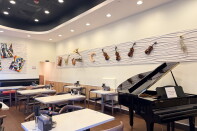 A pair of former piano teachers offers Lanzhou beef noodles and classical music at Chopin Noodle House.
 -
 The property owner has floated preliminary plans to replace Mel’s Drive-In with apartments. Preservationists want it landmarked.


After a few squabbles over punctuality (or lack thereof) and arriving hungry (“Ay, los hambrientos!” my mom calls us), we strap on aprons, put our hair up and make over 10 dozen tamales. We spread masa on the bottom halves of freshly washed hojas and fill them with red stewed pork or green pasilla chile and Monterey Jack cheese as my mom watches like a hawk, ensuring they’re filled proportionately before folding.
Coordinating is hard, and at times, I wonder why we do these burdensome traditions during the busiest time of the year. But the reward of eating freshly steamed homemade tamales on Christmas Eve is worth all the bickering and scheduling conflicts.

The Curiel family assembles tamales on a recent Sunday morning in South San Gabriel.
(
Rolando Tringale
/
Boyle Heights Beat
)
Our family tradition started in the late 1940s on Rowan Avenue in East L.A. For as long as my mom can remember, my grandma’s older sister Petra, one of the first female saleswomen for once popular flour brand La Piña and door-to-door seller of Stanley Home Products (the precursor to Tupperware), hosted the tamalada.
She, my grandma and a couple of Petra’s comadres from the neighborhood savored their time catching up in the dining room around an oval table making savory red pork and beef and sweet pineapple, raisin and cinnamon tamales. My grandpa, Petra’s husband Jerome and his compadres drank and played cards in the living room. Masa was homemade and meats were purchased from an uncle’s carniceria on nearby Brooklyn Avenue (now Cesar Chavez). Children and men didn’t make tamales in my family back then.
It was a woman-led group effort my grandma enjoyed. My mom and aunt played with their cousins, stopping only to eat the first batch of steamed tamales. Already in their flannel Christmas pajamas, they excitedly hopped into their cousins’ beds to await the ringing of bells at midnight. This signaled Santa came and it was finally time to open presents.
Sponsored message

The Curiel family assembles tamales in 2024.
(
Rolando Tringale
/
Boyle Heights Beat
)

The Curiel family assembles tamales in 2024.
(
Rolando Tringale
/
Boyle Heights Beat
)
As family gatherings go, my grandma and grandpa often left Tia Petra’s house in a fight, arguing the short drive home to Clela Avenue, where they’d arrive past 1 a.m. One year, my grandpa got drunk and when Tia Petra asked him to open her present he said he didn’t have to; she always got him the same thing: a Stanley cologne. In the morning, all was forgotten as my grandpa finished making his famous menudo (a recipe my mom and aunt continue to make every Christmas since he passed) and tamales were eaten with fried eggs.
As my mom and aunt started having their own families in the 1970s, the tamalada moved to my grandparent’s house in Montebello. My aunt married a native Hawaiian, so macaroni salad became our signature tamale side.
In the 1980s, rajas con queso tamales were added into the mix and around 1990, I made my first tamal as children started being included in the tamalada. I credit my little sister Carly (my grandma’s favorite) for warming her up to this idea. At 3, she was tasked with washing the hojas.
Today, my husband and our two daughters, my brother and his wife and three kids and my sister and brother-in-law gather every year a couple weeks before Christmas to make tamales at my parents’ house. After my grandma passed away, my aunt’s family splintered off and started having their own tamalada at my cousin’s house in Highland Park.

Kids partake in the Curiel family tamalada.
(
Rolando Tringale
/
Boyle Heights Beat
)
My mom makes the red chile paste that’s added to a pork shoulder often purchased from Superior Grocers and simmered in a garlicky broth for three hours. Chicken is added to rajas and queso and sometimes we make bean and cheese tamales. Masa preparada once purchased from La Mano Tortilleria or Vargas in Pico Rivera is now bought at Super A in Montebello or El Super in Commerce, always doctored with homemade broth. On Christmas Eve, we gather with our extended family and savor the fruits of our labor.
Sponsored message
It wasn’t until two years ago, when my mom was hospitalized, that I jotted down our family’s tamal recipe as my aunt patiently recalled the laborious process to me over the phone, both of us finding solace in tradition as we worried about my mom’s health. I transcribed the barely legible recipe I scribbled on the back of a torn envelope neatly onto index cards and placed it inside my treasured recipe box. It’s, by far, the most sacred recipe of them all.

Senior Vice President News, Editor in Chief


