




One year ago, Congress defunded public media. Now that we're 100% community funded, please become a sustaining member or increase your existing membership today.
Love mezcal? A new festival brings 50 traditional Mexican producers to LA


(
Jakob N. Layman
/
Courtesy Mezcal Por Siempre
)
Mezcal, the once lesser-known smoky cousin of tequila, has become a new marker of urban sophistication in recent years. With that comes a more profound interest in traditional mezcal producers in Mexico, who create small-batch spirits with far more nuance than commercial manufacturers.
Enter Mezcal Por Siempre, a first-of-its-kind mezcal festival on Saturday, Sept. 14, at L.A. River Studios in Highland Park. The event will bring together more than 50 producers from all over Mexico, many of whom will share their mezcal in the U.S. for the first time.
-
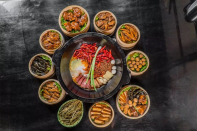 Explore the differences between traditions, from Sichuan’s spicy mala to Japan’s delicate shabu-shabu and Korea’s hearty jeongol.
 -
 These LA-area restaurants could also receive a Bib Gourmand affordable dining award or even a star at the awards event in August.
 -
 Feeling beachy, even if you're not near the ocean? Maybe a quality fish taco could hit the spot.


The organizer is Ivan Vasquez, who owns Madre!, a Oaxacan restaurant with outposts in Torrance, Palms, West Hollywood, and Santa Clarita, where he offers an extensive mezcal and tequila collection, as well as other hard-to-find genres of spirits, such as raicilla and sotol.
“There’s no better place to do this other than Los Angeles. It’s the heart of Mexico in the United States,” Vasquez said.

Ivan Vazquez (left) is hosting Mezcal Por Siempre on September 14 at L.A. River Studios in Highland Park
(
Jon Endow
/
Courtesy Mezcal Por Siempre
)
Vasquez grew up in Valle Central, Oaxaca, just an hour from the state capital, Oaxaca City. There, Vasquez's grandfather ran an “expando,” an informal bar space built inside their house selling mezcal, beer, and snacks to locals. He says that's where he was bit by the hospitality bug, often helping his grandfather pour shots before he could drink, igniting his passion for the spirit.
Sponsored message
Since opening Madre! in the mid-aughts, Vasquez has positioned himself as a steward of mezcal, coinciding with the growing interest in the beverage in the states.
“I wanted to curate mezcal, focus on it, and talk about it because it was my passion. It was something that I grew up with, and I was very proud that mezcal was finally here,” he said.
Expansion concerns
In recent years, Vasquez has watched the mezcal industry expand significantly in the U.S., even outselling whisky and vodka. With that great demand, the mezcal industry, particularly in Oaxaca, has been flooded with outside foreign investment that doesn’t always have the tiny state's best interests in mind.

A mezcalería in Oaxaca, Mexico growing blue Weber agave plants
(
Zyanya BMO
/
Unsplash
)
Consider the mezcal seen at local grocery and other big box stores in the U.S. It’s often made by larger commercial companies that, in an attempt to create monopolies around the product, have significantly ramped up their cultivation of agave plants, the basis of mezcal.
That, in turn, poses severe environmental challenges. The state is already drought-prone, and the overproduction of agave plants causes soil degradation, which can seriously affect the sustainable conditions of future plants.
Sponsored message
Seeing these issues, Vasquez realized American consumers needed to be educated about the difference between commercial mezcal and "mezcal tradicional" — mezcal produced by traditional techniques by small makers.
“People have been making it for hundreds of years, for many generations, five to six generations. They continue to distill it based on the tradition of the pueblo, and that's what we're trying to rescue because we want to keep the tradition alive,” Vasquez said.
What is traditional mezcal?
One significant distinction between traditional and commercial mezcal is the alcohol percentage. According to Vasquez, commercial mezcal has an ABV level under 44% and is usually diluted with water. Meanwhile, traditional mezcal has an ABV of 45% to 70%.
What to expect at the festival
- Producers (and samples) from 14 Mexican states including Oaxaca, Puebla, Guerrero, Michoacan, Jalisco, San Luis Potosi, Sonora, Chihuahua, Durango, Nuevo Leon, and Estado de Mexico y Tamaulipas.
- Panels by mezcaleros and mezcal project founders.
- Food for sale and an after party
- Tickets are available for $75 and are available via Eventbrite.
Another important distinction is the type of agave plant used. Espadín, also known as blue Weber agave, is the most commonly used agave plant in tequila and mezcal. For context, tequila can only be made from blue Weber agave; mezcal, on the other hand, can be made from 30 different species of agaves.
Vasquez points out that a quality mezcal often comes from other agave plant varietals, including tobalá, madrecuishe, and papalometl, which are rare plant forms usually only found in remote areas with specific climates.
Sponsored message
Standouts at the festival will include El Tigre, made from papalote agave, known for its honeycomb flavor profile, and Lamata, produced by fermenting mezcal with pulque instead of water.

Maestra Bertha Vasquez, who produces Rezpiral mezcal in San Baltazar Chichicapam, Oaxaca, will be one of the artisans showcasing her mezcal at Mezcal Por Siempre.
(
Courtesy Mezcal Por Siempre
)
Struggle for recognition
Vazquez also hopes the festival will shed some light on the struggles of smaller mezcal producers who have been fighting for recognition in recent decades.
The Mexican government created what is known as the “denomination of origin” for mezcal in the mid-90s and made it into law in 2003. This law states that all mezcal produced can only come from Oaxaca, Guerrero, Puebla, Michoacán, Tamaulipas, Guanajuato, Zacatecas, Durango, and San Luís Potosí and must be certified by and approved by the Consejo Regulador del Mezcal (CRM). Think of it as a similar designation for Champagne in France or Parmigiano Reggiano in Italy.
According to Vasquez, the creation of such categories erases centuries of mezcal-making traditions and limits the definition of the spirit itself. He hopes to help change the narrative with events like the Mezcal Por Siempre festival.
“I want the next generation of young mezcaleros and mezcaleras to know there is a future for traditional mezcal in the United States," Vasquez said. "There is a light at the end of the tunnel where people can appreciate traditional mezcal. Then, that market can grow slowly by appreciating and educating them. By educating them, they'll understand it and appreciate the families behind them."
Sponsored message

Senior Vice President News, Editor in Chief


