




One year ago, Congress defunded public media. Now that we're 100% community funded, please become a sustaining member or increase your existing membership today.
LAUSD will limit screen time for students at school. How will it work?

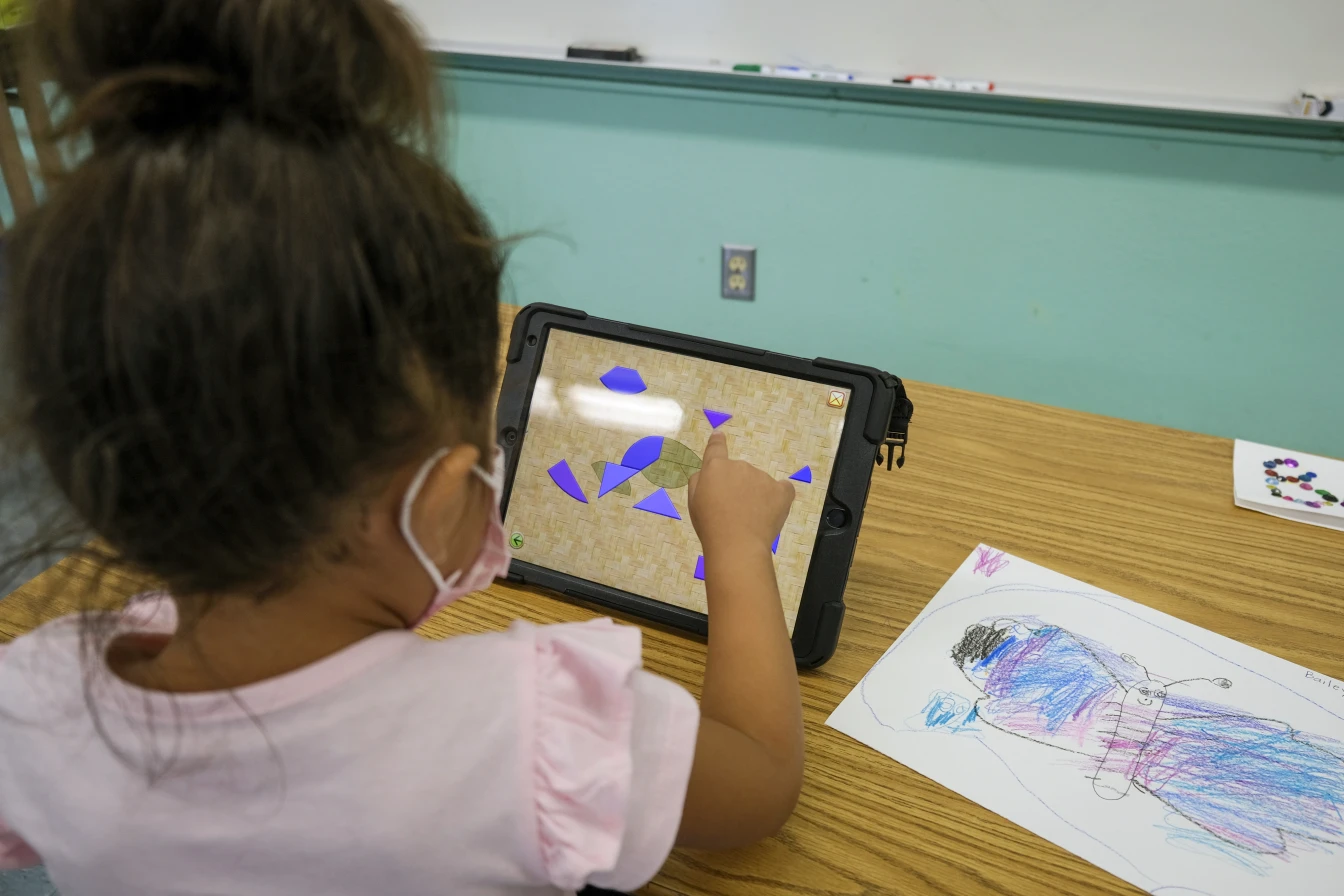
LAUSD officials say there's too much screen time in schools.
(
Mariana Dale
/
LAist
)
The Los Angeles Unified School Board voted unanimously Tuesday on moving toward limiting screen time for students at school.
The resolution requires the school district to create a policy that includes maximum daily and weekly screen time limits based on grade level and “encourage the use of paper and pen assignments.”
“We had not recalibrated or reset our relationship with technology post-COVID,” said school board member Nick Melvoin, who brought forth the measure. “Six years ago, we sent every kid in L.A. home with a device, which was a lifeline. … But when they came back, I'm still seeing kids as young as preschool on devices all day.”
The district will create a policy that the school board will vote on by June and that would be implemented next school year.
Why is the board considering this?
Research has shown excessive usage of screens can hurt children’s mental and physical health.
“Addiction-like use of short-form video content — including YouTube and social media platforms — are correlated with higher levels of social anxiety among adolescents,” the resolution states.
Sponsored message
Sandra Martinez Roe, a parent in northeast L.A., said she had tried to limit screen time at home for her now fourth-grade son, but in second grade, he started bringing home a laptop from school for his homework.
“ I just feel very strongly about children being able to experience childhood and really delaying the tech as long as possible. And when my son came home with a Chromebook and started talking about the Minecraft games and this game and that game, I about lost it,” Martinez Roe said.
Martinez Roe is a member of the parent advocacy group Schools Beyond Screens, which has been pushing for the resolution.
“ He didn't understand why the keyboard wasn't in alphabetical order. And this was a real big concern for me because I thought, he's in second grade, he's learning how to read, how to write, and you're expecting him to do this all on a Chromebook without a typing class first?” Martinez Roe said.
How is this different from the cellphone ban?
While the school district currently has a ban on cell phones throughout the school day that went into effect last year, this resolution is about laptops and tablets that are given to students in the district. The district moved to equip each student with their own digital devices during the pandemic that they could take home.
“There’s still access to YouTube, some games like Roblox, Minecraft. … I've seen some clever kids who know that they can't be on their phones during lunch, will be on their computers during lunch,” Melvoin said.
Sponsored message
What does this resolution mean for early grades?
The measure would ban the student use of digital devices from preschool through first grade, except when needed for district-mandated assessments.
What does it mean for kids second grade through 12th?
The district will set maximum daily and weekly screen time limits for students by grade level. It would also block student-led use of YouTube or other video streaming platforms on district devices.
For students from second to fifth grade, the policy would “encourage schools to utilize laptop carts and/or computer labs.”
The measure would also ban the use of student devices during lunch and recess through middle school — except for teacher-approved work.
For middle and high school students, Melvoin said it’s about creating guardrails on screens versus a strict ban.
Sponsored message
“So the high school student who is in class and sitting on their device and needs to Google it will almost certainly still be allowed to,” he said.
What does this mean for teachers?
The resolution is aimed at student-led use of digital devices. Teachers can still use YouTube and devices for instruction.
“Teachers, even in kindergarten and preschool, who want to put up a video of singing the alphabet song in different languages or some of those morning routines that I see when I'm in preschools [are] unfettered by this resolution,” Melvoin said. “It was really about the students and the ads that come up on YouTube, the algorithm that will send kids from a video about dinosaurs to something that we don’t want them to see.”
Could this mean students use screens more at home?
Melvoin told LAist that’s a fair concern but has heard about students pointing out their parents’ own excessive usage of their cell phones.
“ It's about creating good habits that we hope will trickle up both to their parents and also outside of the school day,” he said.
Sponsored message
Martinez Roe agrees.
“I think that now when you see what's happening to us as adults, where we can barely put our phones down, it's like, it’s going to be three times as hard for our kids, and I don't wanna set my kid up for that — and definitely not do it through the school,” she said.

Senior Vice President News, Editor in Chief


