




One year ago, Congress defunded public media. Now that we're 100% community funded, please become a sustaining member or increase your existing membership today.
CSU went all-in on AI. At UC, students and faculty say AI use is all over the place


Faculty and students say UC schools don't have a consistent approach to AI use.
(
Imen Ben Youssef / Hans Lucas
/
Getty Images
)
Listen
0:48
At UC, students and faculty say AI use is all over the place
Years after generative artificial intelligence software became widely accessible, the University of California system still does not have a consistent approach to using it. Yusra Farzan reports.
Years after generative artificial intelligence software became widely accessible, the University of California system still does not have a consistent approach to how AI is used in classrooms, according to its faculty and students.
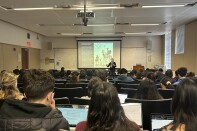
“The situation is contradictory and also extraordinarily fluid,” professor Rita Raley told the university system’s Board of Regents on Wednesday. “In one class, students are permitted to use AI, in another, they're cautioned against it, and in a third, they're told it's prohibited.”
Raley, a professor of English at UC Santa Barbara, heads the breakout group that will define what AI literacy means for UC, and will make recommendations on how to cultivate AI in classrooms across the UCs. The big question the working group is grappling with, Raley said: What every student needs to know about artificial intelligence.
“If we are indeed moving toward automated education, then we have to ask what a UC degree will mean. It will have to mean more than skills because these too can be automated,” she said. “... [W]e must now give students the critical judgment to ask what this technology is, who needs to be accountable for it, how to use it, when to refuse it, and what it could be instead.”
Jayha Buhs-Jackson, UCLA’s undergraduate student body president, says she does not like AI, so she does not use it.
-
 Critics say the cash-strapped system misspent millions of dollars getting upgraded accounts for all students. CSU leaders insist they're needed to meet a changing economy.
 -
 A closed-loop system aims to empower, not replace, professors in subjects including literature and physics. And it appears to be improving student outcomes too.
 -
 Older and wiser from one academic year with Open AI’s ChatGPT, faculty at community colleges have recognized that their students are no strangers to generative AI tools.


She agreed that the university does not have a “succinct” AI policy. Some of her professors, Buhs-Jackson said, strictly do not allow AI in the classroom; others allow it for research and coding.
Sponsored message
She said UCLA has its own internal AI committee, which she was just appointed to.
“ I'm curious to see … how I could use my voice as president to discuss and uplift the undergraduate student voice related to AI at UCLA,” she said.
UC vs CSU approach
The UC system currently does not have a single systemwide AI product or mandatory AI protocols in place.
Instead, “eligible employees have access to frontier AI tools from a variety of vendors including OpenAI, Microsoft and Google. Access is intended to support activities such as analysis, research, learning, and operational efficiency,” a University of California spokesperson said.
The university system also has a Master Service Agreement in place with OpenAI, but it does not include a minimum spend commitment or prepurchased licenses. Schools under the UC umbrella can purchase OpenAI products through the agreement.
UC’s approach stands in contrast to the one California State University took.
Sponsored message
In 2025, the nation’s largest public university system signed a nearly $17 million contract with OpenAI and made a suite of ChatGPT tools available to all its faculty and students.
At the time, CSU spokesperson Amy Bentley-Smith told LAist, the goal was for all students to have “the same access to the tools and learning opportunities that will prepare them for the future,” regardless of which campus they attend.
Still, the rollout was heavily criticized as students and faculty were left on their own to figure out how to use AI. And in a 2025 survey of CSU students, over 60% said AI has negatively affected their learning experience.
Support education coverage
What's the best approach for schools?
The different approaches taken by California’s public university systems demonstrate that higher education is still grappling with how to confront — or embrace — this technology.
Universities across the nation have to find ways to work with AI, said Justin Reich, a professor of digital media and the director of the Teaching Systems Lab at MIT.
Sponsored message
We don't want our brains to atrophy while we're trying to get better at what we're doing.
— Stephanie Valadez, UCLA student
But we also do not have a framework for what to do or how to implement AI in higher education, he added.
”The right strategy is to come up with a systematic series of experiments, where you're testing hypotheses, in particular, by looking at student learning experiences and student learning outcomes,” Reich said.
The University of California’s AI steering committee overall is tasked with “developing a coordinated approach that allows UC to use its systemwide scale while recognizing the distinct needs of its campuses, medical centers, laboratories, faculty, researchers, staff, and students,” according to a University of California spokesperson.
Reich said it is great that the University of California has multiple voices involved in the steering committee.
“I would encourage any university system to have students play a central role in directing their AI response pretty much at all levels,” he said. “Especially in a system as complex as UC, where you have so many students that have so many different kinds of expertise.”
The UC AI steering committee has one student voice on it. Stephanie Valadez, an ethnomusicology graduate student at UCLA and president of the UC graduate and professional student council, says she would like to see more. She’s concerned about the environmental impact of AI and the negative impact on “underrepresented communities that are living near these data centers,” she said.
Sponsored message
In the classroom, she hasn’t had to use AI.
“ All of my professors say, ‘Don't use AI. Just don't use ChatGPT, don't use Claude, don't use any of that stuff,’ for multiple reasons,” she said. “Being in the music department, as an artist, we also are very conscious of having our work stolen, having what we produce then go on to train AI.”
The training a Ph.D. student is seeking, Valadez said, you would not get from AI.
“ We don't want our brains to atrophy while we're trying to get better at what we're doing,” she said.
What comes next for UC
UC San Diego and UC Irvine, Valadez said, have rolled out TritonGPT and ZotGPT, but she’s heard from other board members that students aren’t using the AI tools as much as the university would like them to, adding that there has been “a lot of pushback from students.”
James Milliken, the University of California president, said the committee’s guiding principle is AI “for humans and for humanity” and how it “ can advance human potential, not diminish it.”
The committee had its first meeting in June, where five working groups were created to explore how to use AI in clinical research, curriculum development and “public benefit” among other things.
Come October 2027, the committee will come to Milliken with a proposal for a UC sovereign AI cloud. This means UC could have its own hardware and processing power to build, run and train AI models.

Senior Vice President News, Editor in Chief


