




One year ago, Congress defunded public media. Now that we're 100% community funded, please become a sustaining member or increase your existing membership today.
Carcinogen detected during LA fire cleanup may have spread up to 9 miles downwind, study shows


Workers with the U.S. Army Corps of Engineers spray hydro seedling over a cleared property in Altadena in April 2025.
(
Brian Feinzimer
/
LAist
)
A potent carcinogen may have spread to communities as far as nine miles downwind of the Eaton and Palisades fire burn zones during debris clean-up, according to a new peer-reviewed study in the journal Nature.
A team of researchers has been studying the air pollution effects of clearing the remains of more than 16,000 homes and businesses destroyed in the 2025 fires.
Scientists with UCLA and UC Davis drove through Altadena and Pacific Palisades in an electric vehicle with mobile air monitors periodically over about seven months after the fires. They measured nanoparticles of hexavalent chromium, or chromium-6, within the cleanup areas. Paint, auto parts, electronics and fire retardant are possible sources, but more study is needed to understand where the chromium came from, the researchers said. They also detected other airborne metals, including lead and arsenic.
The researchers used computer modeling to understand how far those airborne particles may have spread beyond the immediate burn zones. About 3 million people live in the areas that could have been exposed, according to the scientists’ models.
The highest concentrations of nanoparticles — particles less than 1/1,000th the width of a human hair — were measured in March 2025, about two months into the debris removal effort in both burn zones. But the toxicity declined as time passed.
“ The good news is that some of those toxic metals, they were converted back to less toxic forms over time,” said Michael Kleeman, professor of civil and environmental engineering at UC Davis and lead author of the study. “So in the months after the wildfire, the threat from this sort of decayed away.”
Sponsored message
In communities outside the burn zones, concentrations diluted further as the plume moved downwind, Kleeman said. By eight months after the fires, the researchers measured that heavy metal concentrations had fallen to background levels for the L.A. basin.
The research highlights how “even after the fire is over, the danger isn't gone,” Kleeman said.

An aerial view of properties cleared of fire debris in Altadena in July 2025.
(
Mario Tama
/
Getty Images
)

Cleared lots in the Palisades Fire burn zone stretch into the distance.
(
Qian Weizhong
/
VCG / Associated Press
)
How concerned should you be?
The researchers and outside experts emphasized to LAist that the study’s findings do not prove widespread contamination of homes, businesses or the environment.
“ I hope we can get a message of caution out there, but not panic,” said Kleeman.
Andrew Whelton, a Purdue University post-disaster environmental risk researcher who was not involved in the study, said the research is far from proving what, if any, harm to human health could occur, especially because no indoor testing was carried out.
Sponsored message
“Drawing a line from street-level detections to indoor exposure, without confirming that the [chromium-6] outdoors entered homes at levels posing health risks, is a significant leap,” he said.
Whelton, who carried out soil testing in the L.A. fire burn scars, said he worries the paper could needlessly sow fear because so many open questions remain. He has argued for funding and establishing more comprehensive contaminant testing at the individual household level in the wake of such destructive fires — the most definitive way to know your personal risk.
“The bottom line: detecting nanoparticles in outdoor air does not mean harm occurred to 3-plus million people living and working inside buildings,” Whelton told LAist.
The average levels of chromium-6 detected in the air during debris cleanup in March were well below limits set for workplaces by the Occupational Health and Safety Administration, but above the U.S. Environmental Protection Agency long-term screening levels for homes, according to the study.
Still, those comparisons are imperfect because the particles measured were far smaller than what’s used for current health standards — meaning they can more easily travel throughout the body, Kleeman said.
“We don't know for sure what the concerning level should be,” he said.
Workplace standards, for example, are set for healthy adults working eight-hour shifts, “rather than for sensitive populations such as young children, pregnant individuals, older adults, or people with chronic illness,” said Jun Wu, an environmental health scientist and professor at UC Irvine’s School of Public Health, who also was not involved with the study.
Sponsored message
More comprehensive study is needed to get at what true exposures may, or may not, have occurred, Kleeman and outside researchers emphasized.
“This is a single, novel finding based on limited sampling, with the downwind reach estimated by modeling,” Wu said, “so broader monitoring is the natural next step.”
-
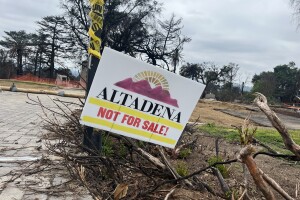 We talked to experts and looked at the fine print to better understand the utility's payout plan for Eaton Fire survivors.
 -
 An expert explains what survivors of the Palisades and Eaton fires should consider before joining a fire-related lawsuit.


Where the nanoparticles may have spread
The broadest potential plume was from the Palisades Fire, spreading as far as the southern San Fernando Valley to the north and Beverly Hills and West Hollywood to the east. Kleeman said computer modeling of prevailing winds show the plume being pushed toward central L.A.
“Santa Monica, Venice and moving toward central L.A. took the brunt of the plume,” Kleeman said.
Prevailing winds didn’t spread the plume quite as far in communities near the Eaton Fire, with modeling showing northeast Pasadena being the primary community affected.
Sponsored message

A map from the study showing the ZIP codes where a airborne chromium-6 may have spread during debris removal.
(
Courtesy UCLA / UC Davis
)
Many unknowns remain about the public health effects of catastrophic fires in urban areas — and how far those risks may drift beyond the burn zone.
“More work is needed to understand how widespread and persistent these particles were, how exposure varied by location and cleanup activity, and what the health risks were for nearby residents,” said Sina Hasheminassab, an air quality researcher at NASA’s Jet Propulsion Laboratory who was not involved in the study.
How to protect yourself during and after a major urban wildfire
Debris cleanup workers and residents in or within nine miles downwind of the burn zones in the year after the L.A. fires should be mindful of any new health symptoms and report them to a doctor. You can also find resources, report symptoms or ask questions via the ongoing LA Fire Health Study.
Steps to take to reduce contaminant exposure during or in the wake of an urban wildfire:
- Your HVAC system should have MERV-13 or higher HEPA filters.
- Standalone air purifiers should have HEPA and carbon filters.
- If there’s a risk of exposure to smoke or particles from active fire or debris cleanup, wear an N95, KN95 or equivalent mask outside. Keep windows and doors closed at home. Consider putting wet towels or more secure types of sealants along sills and doorframes to help prevent smoke or dust getting in.
- Wipe down dusty areas with wet cloth to prevent particles from becoming airborne.
- Don’t bring potentially contaminated clothing or shoes indoors.
The surest way to understand your personal risk of exposure to toxins is to get your home’s air and soil tested. Here are some resources to learn more about that and what to test for:
- Post Fire’s expert Q&As answer many common questions from fire survivors.
- The L.A. Fire Health Study also has these resources.
- Purdue University has recorded webinars for various aspects of fire recovery, as well as helpful information for soil testing here and here.
Additionally, the study raises questions about how to better protect people’s health not only during, but also after destructive urban fires, said Wu.
“Much of our attention goes to the smoke during the active fire, but this study points to the cleanup and recovery phase,” she said. “This time window deserves just as much attention as the fire period itself.”
For example, some survivors whose homes survived never left during debris removal — some cited concerns about not being able to afford another place to stay without upfront insurance payouts, as well as worries about looting.
The study notes that workers in the burn zones faced the highest risk.
“Based on our field observations, many workers in the debris cleanup zone did not wear masks despite California requirements to provide approved air purifying respirators to workers,” the researchers wrote.

Crews remove wildfire debris on hillside property in Pacific Palisades last year. Researchers note in a recent study that many workers they saw weren't using respiratory protection.
(
Charles Delano
/
U.S. Army Corps of Engineers
)
Survivors push for policy to protect public health after wildfires
Nicole Maccalla’s home in Altadena was damaged but ultimately survived the Eaton Fire. She and her two teenagers moved back in nearly six months after the fire, while debris removal was ongoing. Her daughter’s school nearby was also reopened just a month after the fires.
“ I know I was exposed. I know my kids were exposed,” Maccalla told LAist. “I'm not really sure what to do with that, to be honest.”
“Our entire community is really now guinea pigs,” she added. “It’s deeply concerning.”

Nicole Maccalla, with her kids, Seb and AJ. Their Altadena home survived the Eaton Fire but suffered serious smoke damage.
(
Courtesy Nicole Maccalla
)
Maccalla, a data scientist and member of Eaton Fire Residents United, helped guide ongoing research by scientists like Kleeman to better understand the levels of contamination after the fires.
She said this study is a warning.
“ I think in the future, we need to move a little slower in fire recovery. The goal should not be speed. The goal should be health and safety,” Maccalla said. “We rushed it, and I hope that we learn from this mistake.”
She and fellow survivors see some hope in a new bill they helped inform. AB 1642, or the Wildfire Environmental Safety and Testing Act, is making its way through the California Legislature.
The bill, written by Assemblymember John Harabedian, would establish the first statewide health standards for testing and cleaning up debris in and outside standing homes, schools, businesses and other structures after a wildfire.
Maccalla urged fellow survivors worried about the results of this study to prioritize caring for their mental and physical wellbeing.
“The stress of all of this is just going to be an added component that will be another contributor to us getting sick long term,” she said. “So many of us are still in survival mode. It's time, I think, to start taking care of ourselves a little bit.”
-
 Person with ‘history of sleeping on the job’ held critical role during Eaton Fire, complaint allegesAn L.A. County employee makes the allegation in a whistleblower complaint and in interviews about the response to the deadly fire. County officials dispute the allegations.
 -
 LAist asked what rebuilding your life means after a disaster. Fire survivors shared.
 -
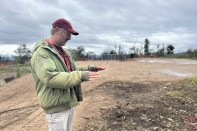 Hundreds of Altadena residents want to rebuild with a modern sewer system, but that's proving to be harder and more expensive than they expected.


Senior Vice President News, Editor in Chief


