




-
Listen Listen
LA County's hospice fraud problem

Credits
Reporting: Aaron Schrank
Analysis: Aaron Schrank and Brian Frank
Graphics: Brian Frank
Editing: Mary Plummer and Megan Garvey
How we reported this series
To report this series, LAist reviewed state licensing records, federal Medicare data, court records and government reports. We also interviewed researchers, regulators and industry representatives.
We analyzed California Department of Public Health licensing records (updated in mid-October) to count active hospice licenses in L.A. County and see where they’re registered. The department also gave us a list of 224 of the L.A. County hospices whose licenses it has revoked, covering those revoked before June 1. To map the hospice locations, we compared the state’s data against local parcel data. This enabled us to group licenses registered to the same property even if they were in different units, and it allowed us to correct a few mapping errors in the state data. Brian Frank, a data journalist, used AI to help write the analysis code, then reviewed and tested it before use.
We also compared administrators’ names, phone and fax numbers and suites with those on revoked licenses. Names can belong to more than one person, so matches alone don’t prove the same people are involved.
To compare L.A. County with the rest of the country, we used federal Medicare data:
- Fourth-quarter 2026 hospice enrollment file to count hospices eligible to bill Medicare
- The Provider of Services file for Medicare terminations
- CMS’ Service and Spending Variation Index (fee-for-service Medicare, fiscal year 2025) for length of stay and live discharges
- Also, its geographic variation and hospice utilization files for payments per patient.
- Payment comparisons are adjusted for regional differences in payment rates.
We visited six San Fernando Valley office buildings where state records showed multiple hospices registered to suites. We checked every listed suite for a hospice and compared those hospices against warning signs of potential fraud, including ties to revoked hospices, high live-discharge rates and administrators listed at more than one.
We also reviewed the 2022 state audit, the state’s emergency and proposed regulations, and the L.A. County Department of Public Health’s August report on hospice oversight. Information about fraud cases comes from charging documents, court records and announcements from the U.S. Department of Justice and the California attorney general’s office.
Support your source for local news!
-
 The L.A. regional homelessness agency says it was correcting errors to comply with federal requirements.
-
 LAHSA executives blamed the delay on a “perfect storm” of leadership changes and competing priorities within LAHSA’s finance department
-
 As of Tuesday, around 3,400 volunteers had signed up. That's less than half of the total number of volunteers LAHSA requested.
-
 About 40% of those invoices are more than two months old. Providers tell LAist the stress caused by late payments is disrupting the system.
-
 LAHSA is fighting a Trump administration freeze on federal grant activity.
-
 A former L.A. city prosecutor will run region’s homeless services agency. Critics say she has pursued policies that criminalize homelessness.
-
 One LAHSA commissioner is ‘deeply disappointed’ with the delay.
-
 The homelessness agency says it needs to reassign staff amid budget reductions
-
 In January, volunteers counted 3,595 people experiencing homelessness in Long Beach, compared with the 3,376 people counted in January 2024.
-
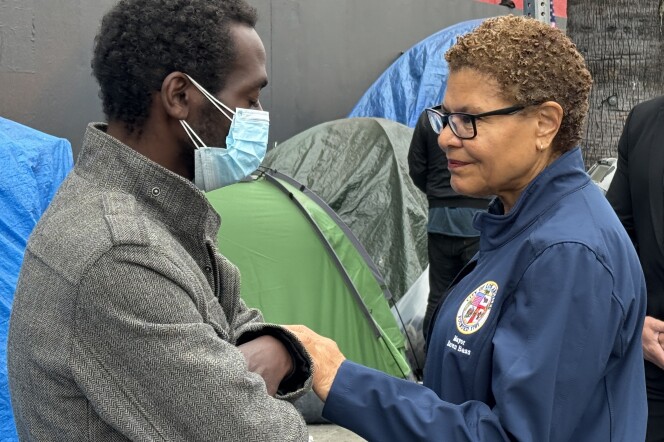 LA mayor says emergency declaration was meant to be temporary, cites progress on homelessness.
-
 The new sales tax divides $96 million among L.A.’s 88 cities.
-
 Voters who approved the sales tax increase in 2024 were promised a new approach to the crisis.


