David Wagner
covers housing in Southern California, a place where the lack of affordable housing contributes to homelessness.
Published October 24, 2024 6:15 AM
(
Megan Garvey
/
LAist
)
Topline:
A new survey reveals nearly universal agreement among Los Angeles County residents that homelessness in the region is a problem. Nearly 1 out of 10 respondents reported having experienced homelessness themselves.
Some key details: More than 60% of Angelenos polled by USC Dornsife researchers for the L.A. Barometer survey said they see unhoused people in the region on a daily basis and nearly a quarter said they had experienced housing instability as an adult, from couch-surfing to living in tents on the street.
Why it matters for the election: The survey shows that a large majority of Angelenos support a wide range of policies to address homelessness. L.A. voters will get a chance to weigh in on these issues in November through ballot measures such as Prop. 33, which aims to allow cities to expand rent control policies in California, and Measure A, a proposed L.A. County sales tax increase to fund homelessness response efforts.
Read on… To find out what survey respondents think is driving L.A.’s homelessness crisis.
A new survey reveals nearly universal agreement among Los Angeles County residents that homelessness in the region is a problem. And nearly 10% of respondents reported having experienced homelessness themselves.
The details
USC Dornsife researchers published new results from the L.A. Barometer survey on Thursday. Some of their findings include:
93% of Angelenos said homelessness is a problem in L.A.
63% said they see people experiencing homelessness on a daily basis
9% said they’ve experienced homelessness themselves, a number that rises to 21% for L.A.’s Black residents
Nearly one-in-four Angelenos (23%) said they’ve experienced some form of housing instability as an adult, including everything from couch-surfing with friends or family to staying in motels, vehicles or tents on the street
About the methodology
The results were based on a survey of about 1,500 L.A. County residents that took place between late June and mid-October.
What people think is causing the crisis
Respondents were most likely to point to mental illness (85%) and addiction (84%) as the top factors driving L.A.’s high homelessness numbers.
Fewer respondents pointed to the cost of housing (78%), unemployment or financial hardship (74%) or racism (31%).
Kyla Thomas, a USC sociologist who directs the L.A. Barometer survey, said while mental health and substance abuse issues contribute to homelessness, research shows they’re not the top drivers — even though many people think of them first.
“The research shows also that the cost of housing and housing supply is a bigger part of the problem,” Thomas said. “It's interesting to see how people seem to see that as less of a contributor even than mental health.”
People are still looking for solutions
The survey also found that large majorities of Angelenos support a wide range of policies to address homelessness. Those include:
Mental health and drug treatment (87%)
The creation of more affordable housing (81%)
Rent control (79%)
Why that could matter in this election
L.A. voters will get a chance to weigh in on these issues in November through ballot measures such as Prop. 33, which aims to allow cities to expand rent control policies in California, and Measure A, a proposed L.A. County sales tax increase to fund homelessness response efforts.
By David Rodriguez and Kevin Martinez | LAist and The LA Local
Published August 13, 2026 10:00 AM
The LAist community engagement team tabled at Café Calle in South Central for Local News Day LA.
(
Alejandra Santamaria
/
LAist
)
Topline:
Recently LAist, The LA Local and 12 other L.A.-area newsrooms collaborated to build connections with community members at coffee shops across Los Angeles on the same day. The event — which we called Local News Day LA — demonstrated the power of collaboration and community relationships in L.A.'s local news ecosystem.
Why this was unique: Although LAist has made it a recurring practice to meet community members in person to hear what's on their minds, doing it alongside our local news parters on the same day helped bring hundreds of Angelenos closer to local newsrooms.
Any newsroom can do this: If you're at a newsroom that's never done a community pop-up event, LAist and The LA Local have tips on how you can get started.
Read on... for what we learned from the first-ever Local News Day LA.
As local news organizations nationwide navigate funding cuts, rapid changes in technology and shifting audience habits, building relationships directly with communities has become more important than ever. It’s also something newsrooms don’t have to do alone.
On June 27, LAist, The LA Local and 12 other L.A.-area newsrooms came together to meet community members at coffee shops across Los Angeles County. We called it Local News Day LA.
Here are five things we learned from holding this event for the first time, why it was worth it, and how other local newsrooms can organize their own events.
1. Communities will show up when you show up
This pop-up event, organized by The LA Local, allowed residents across the county to meet the journalists covering their communities.
A total of 14 media partners participated. In addition to LAist and The LA Local, newsrooms included CalMatters, LA Public Press, L.A. Taco, Calo News, Long Beach Post, The Eastsider, Los Angeles Reporting Collective, LA Sentinel, Q Voice News and USC Annenberg Media.
More than 400 people participated in the event by talking with a local journalist. For some, it was the first time they'd ever heard of that newsroom.
While LAist and The LA Local have both made it a recurring practice to meet community members in person to hear what's on their minds, many other newsroom partners didn't have experience with this kind of event. Afterward, journalists at some of those newsrooms said they were surprised that local residents actually wanted to meet them and share story ideas or feedback on recent coverage like the Lineage Fire in Boyle Heights.
CalMatters spoke with community members at Yia Caffe in Boyle Heights for Local News Day LA.
(
The LA Local
)
Others were also amazed at people’s willingness to travel from coffee shop to coffee shop to connect with as many media partners as possible.
Local News Day LA gave them a reason to come out and partners to help with the logistics and outreach — and people showed up to meet them.
2. What we heard from residents checked our assumptions and shaped our reporting
LAist spoke with dozens of community members at Café Calle in South Central for Local News Day LA. Among other topics, they shared with us that the effect of the immigration raids is still present in South Central, the neighborhood needs more spaces and resources for school-age kids, and that residents are frustrated by the amount of trash on the streets, even after cleaning it up themselves.
At a few coffee shops around L.A., The LA Local and Boyle Heights Beat spoke with residents in Koreatown, Inglewood and Boyle Heights. At OpenMarket, folks shared their concern regarding street safety.
At Asteroid Vinyl Cafe in Inglewood, residents expressed frustration over what they said was lack of transparency on Destination Crenshaw’s timeline for completion. And at Picaresca Cafe, community members shared their thoughts on the elected officials’ response to the Lineage Fire that impacted Boyle Heights and East LA.
The Long Beach Post staff spoke with community members at Wrigley Coffee in Long Beach for Local News Day LA on June 27.
(
Kris Kelley
/
The LA Local
)
The Long Beach Post connected with residents at Wrigley Coffee in Long Beach. Some asked for more coverage of small businesses, more coverage in West Long Beach and more investigative reporting.
These conversations reflected what people were thinking about long after the day's headlines had faded and gave participating newsrooms strong signals about how to focus their time and energy next.
3. Collaboration can be more powerful than competition
Local News Day LA was the first collaboration held across all our news partners — and it started small. In 2025, LAist and The LA Local shared best practices and tips with each other from our respective experiences tabling and meeting community members to see what we could learn.
We then started brainstorming a larger collaboration, eventually rallying our partner newsrooms and holding a workshop on what we learned about planning a successful tabling event, engaging residents and collecting feedback to influence our journalism.
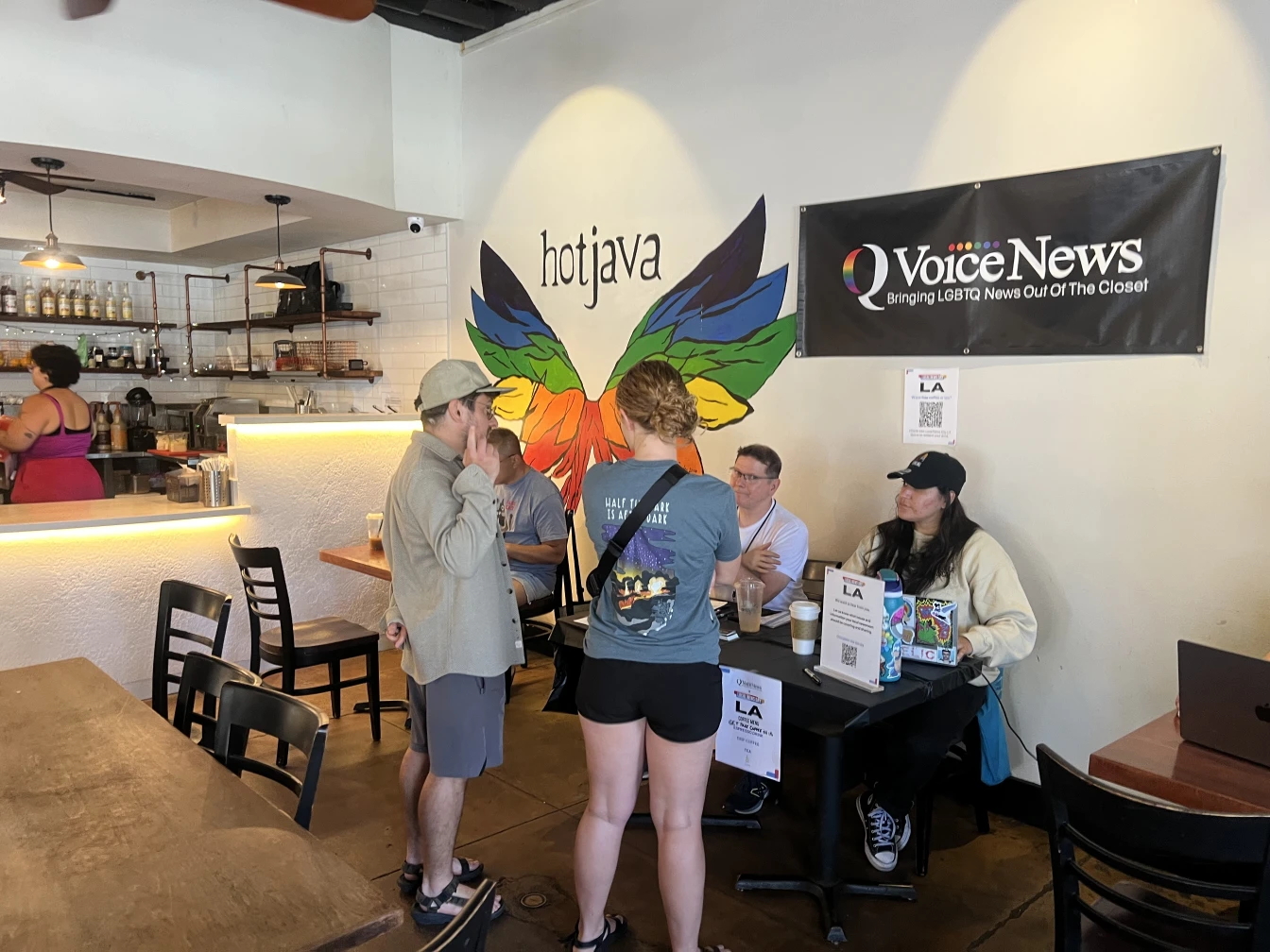
Q Voice News spoke with residents at Hot Java in Long Beach for Local News Day LA.
(
The LA Local
)
Local News Day LA showed that collaboration can strengthen local journalism. In an industry where newsrooms often compete for scoops, audiences and resources, the event demonstrated what’s possible when they work together to listen to communities and better serve residents.
4. Partnerships with local businesses can benefit everyone
While Local News Day LA was primarily about connecting residents with their local news outlet, it was also about supporting and elevating local businesses — each newsroom partnered with coffee shops across L.A. The LA Local supported all media partners with $250 to provide free coffee to residents that came out and connected.
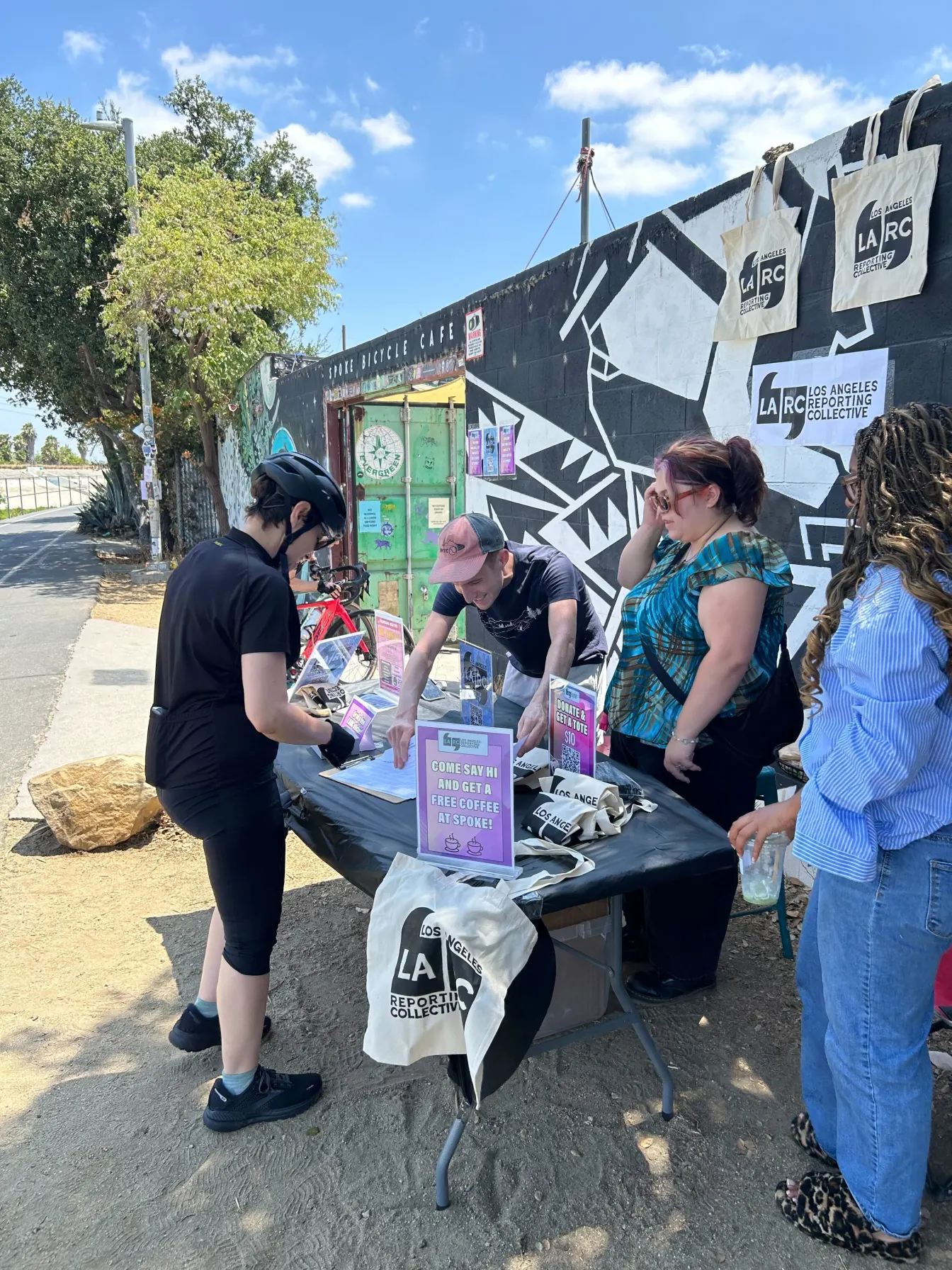
Los Angeles Reporting Collective engaged with community members at Spoke Bicycle Cafe in Frogtown for Local News Day LA.
(
The LA Local
)
Newsrooms got a chance to see the kind of relationships coffee shops already had with people in the neighborhood. LAist journalists learned what a trusted community hub Café Calle was for residents nearby — and we're already making plans to go back. Coffee shops participating in the event also received additional foot traffic while also offering a space for community members to have conversations with journalists and each other.
5. Any newsroom can do this — here’s how
The LAist community engagement team tabled at the Crenshaw Farmers Market on July 11.
(
Sabrina Sanchez
/
LAist
)
An LA Local cafecito event at Asteroid Vinyl.
(
Amir Vera
/
The LA Local
)
If you're at a newsroom that's never done a pop-up community tabling event, you can get started on your own even without a big collaboration. Here's a quick checklist:
Reach out to the local business or program in a specific community you want to engage with.
Clearly outline your goal for tabling. Is it to hear about a specific topic or is it more general?
Promote your event. Talk about it on your social media, newsletters, website and any other format you have to engage with your audience.
Tell community members about your organization! Now is the time to distribute merch or resources you might have. LAist has shared a resource on how to talk to a journalist when at tabling events.
Take notes! You’ll want to reflect on them later.
Have people sign up so you can follow up. Think about a quick check in through a QR code or physical sign-in sheet.
Plan out what is next from what you’ve heard. Reflect on the response and share immediate follow ups for news coverage.
More to consider
Here are other details to get a grasp on before and after your event:
Which days and times have the highest foot traffic? Check with the business or venue you're partnering with. (It might be during the weekend.)
Set your budget if you’re buying participants coffee or any food from the shop, or if you need to order new merch.
Think about naming your event if you plan to do more of them at local shops.
Have an activity in mind so participants feel engaged (e.g. spinning wheel, drawing, coloring, etc.).
Consider your existing relationships with partners you can lean on.
Prepare and discuss with your team! Try a few check-ins ahead of the event and a debrief to discuss what worked.
For more information about how to be a part of LAist’s reporting, visit LAist.com/Community. If you want to read more about The LA Local’s community engagement work, visit TheLALocal.org.
Mayor Karen Bass, joined by city, county and state representatives, provides an update at City Terrace Park on the Boyle Heights warehouse fire on June 20, 2026.
(
Isaiah Murtaugh
/
The LA Local
)
Topline:
Los Angeles Mayor Karen Bass will hold a public community forum Thursday to provide an update on the cleanup at the Lineage warehouse fire site as the company races to beat a Friday deadline to remove all the food waste.
More details: The hybrid webinar/community meeting begins at 6 p.m. Thursday. Though residents will have the opportunity to watch in person at Lou Costello Jr. Recreation Center in Boyle Heights, Bass, other elected leaders and guest speakers will join virtually via Zoom. Community members can also participate via Zoom.
The backstory: It’s been almost two months since the Lineage cold storage warehouse caught fire and caused a deluge of issues for residents in Boyle Heights, East L.A. and surrounding communities. Families continue to navigate a maze of resources from city and county entities and deal with the ongoing smell of rotting food, flies and pests.
Los Angeles Mayor Karen Bass will hold a public community forum Thursday to provide an update on the cleanup at the Lineage warehouse fire site as the company races to beat a Friday deadline to remove all the food waste.
The hybrid webinar/community meeting begins at 6 p.m. Thursday. Though residents will have the opportunity to watch in person at Lou Costello Jr. Recreation Center in Boyle Heights, Bass, other elected leaders and guest speakers will join virtually via Zoom. Community members can also participate via Zoom.
It’s been almost two months since the Lineage cold storage warehouse caught fire and caused a deluge of issues for residents in Boyle Heights, East L.A. and surrounding communities. Families continue to navigate a maze of resources from city and county entities and deal with the ongoing smell of rotting food, flies and pests.
The forum will address “the status of warehouse clean-up and highlight available resources for residents, workers, and small businesses,” according to Bass’ office.
As of Wednesday, Lineage said it has removed 92% of the food waste from the site and is determined to meet the mayor’s 45-day deadline Friday.
Bass’ office did not immediately return a request for more information on the community forum and who will be in attendance.
How to attend the forum
Registration is encouraged to attend in person and virtually. To register, click here. Once you register, you will receive a link to the Zoom webinar.
In person: Lou Costello Jr. Recreation Center, 3141 E. Olympic Blvd., Los Angeles
If you're enjoying this article, you'll love our daily newsletter, The LA Report. Each weekday, catch up on the 5 most pressing stories to start your morning in 3 minutes or less.
Jill Replogle
covers public corruption, debates over our voting system, culture war battles — and more.
Published August 13, 2026 5:00 AM
Former Orange County Supervisor Andrew Do steps into a vehicle after pleading guilty to bribery last year.
(
Trevor Stamp
/
LAist
)
Topline:
A year after disgraced former Orange County Supervisor Andrew Do reported to federal prison to serve time for bribery, evidence continues to surface of widespread corruption and mismanagement of taxpayer dollars during his time in office: A county report released Wednesday found that millions of dollars in COVID-era contracts and grants were directed by Do and another top county official with no competitive bidding and little to no accounting of how the money was spent.
The backstory: The new report comes amid a forensic audit of pandemic-era contracts ordered by the Orange County Board of Supervisors in the wake of the Do scandal. Do pleaded guilty to a federal bribery charge in 2024 following a more than year-long investigation by LAist that found he directed some $13 million in taxpayer funds to an organization affiliated with his daughter, Rhiannon, who was a student at the time.
Key details: The audit report released Wednesday recounts numerous times that top county officials were alerted to, but didn’t act on, potential irregularities regarding millions in taxpayer funds awarded to a nonprofit connected to Do’s adult daughter, Rhiannon Do. The audit details one occasion in which Clayton Chau, the former county health care director, reprimanded a subordinate for raising concerns and stated “that Supervisor Do was a lawyer and he would know if there was a conflict.” Chau did not return a text and message from LAist left on his voicemail.
A year after former Orange County Supervisor Andrew Do reported to federal prison to serve time for bribery, evidence continues to surface of widespread corruption and mismanagement of taxpayer dollars during his time in office.
A county report released Wednesday found that millions of dollars in COVID-era contracts and grants were directed by Do and another top county official with no competitive bidding and little to no accounting of how the money was spent. Overall, the report paints a picture of a local government facing an unprecedented public health crisis, flush with federal relief dollars, but with minimal guardrails to ensure those dollars were properly spent.
For example, Do awarded a $500,000 small business grant in May 2021 to Bridgecreek Realty Investment Corp. to expand outdoor dining in Little Saigon during the pandemic. But the audit noted that the contract never required Bridgecreek to provide supporting documentation for how the money was spent — such as invoices or receipts. In the end, there is no documentation for how more than half of the taxpayer funds were used.
LAist left a voicemail with Frank Jao, owner of Bridgecreek, requesting comment and will update this story if we receive a response.
The audit also details the numerous times that top county officials were alerted to, but didn’t act on, potential irregularities regarding millions in county funds awarded to a nonprofit connected to Do’s adult daughter, Rhiannon Do. The audit details one occasion in which Clayton Chau, the former county health care director, reprimanded a subordinate for raising concerns and stated “that Supervisor Do was a lawyer and he would know if there was a conflict.”
Chau did not return a text and message from LAist left on his voicemail. We will update this story if we receive a response.
Frank Kim, the former Orange County chief executive, was also interviewed by the auditors. The audit said he was also aware of the alleged conflict of interest, but failed to consult with the county’s top lawyer at the time. Instead, according to the audit, he relied on the word of Do’s then-chief of staff, Chris Wangsaporn, who assured Kim there was no conflict.
LAist left a voicemail on Wangsaporn’s cellphone seeking comment and will update this story if and when we receive a response.
“It’s not an excuse, but that was a strange time,” Kim, the former county CEO, told LAist on Wednesday. Referring to the pandemic and the audit’s findings, Kim added: “None of the processes were really set up to deal with emergencies.”
Kim told LAist he had trusted the supervisors and top county staffers.
“I never thought there would be fraud," he said. “These were people I had worked with for a long time. I never thought they would do something like that.”
Several county supervisors were quick to react to the audit findings, calling for even deeper investigation into what Supervisor Donald Wagner called “potential additional abuses of taxpayers’ dollars.”
Supervisor Janet Nguyen, who was elected to replace Do, said Do and Chau had “scammed taxpayers in the most difficult time of their lives.” She also said the audit showed the county had “routinely bypassed its own rules” for contracting with outside entities.
Supervisor Katrina Foley said the report exposed “deficiencies in oversight and accountability that the board continues to address,” adding that the county must complete the next two scheduled phases of the forensic audit to “uncover remaining problems, strengthen our controls, and protect taxpayers from corruption and abuse.”
The backstory
The new report is the result of the second phase of a forensic audit of major pandemic-era contracts ordered by the O.C. Board of Supervisors in the wake of the Do scandal. The outside firm Weaver is conducting the audit.
Do pleaded guilty to a federal bribery charge in 2024 following a more than year-long investigation by LAist that found he directed some $13 million in taxpayer funds to an organization affiliated with his daughter, Rhiannon, who was a student at the time. Most of that money was slated to provide meals and services for needy residents of Do’s district during the COVID-19 pandemic.
Instead, at least $550,000 of the funds was rerouted back to Do and his two daughters in the form of bribes, according to federal officials, while just 15% was used to feed residents.
Do will complete his first year in prison on Saturday. He’s scheduled for release in June 2029, according to the federal Bureau of Prisons.
How to watchdog your local government
One of the best things you can do to hold officials accountable is pay attention. Your city council, board of supervisors, school board and more all hold public meetings that anybody can attend. These are times you can talk to your elected officials directly and hear about the policies they’re voting on that affect your community.
The Orange County Board of Supervisors meets on alternating Tuesdays at 9:30 a.m. at 400 W. Civic Center Drive, Santa Ana. You can check out the O.C. Board of Supervisors full calendar here.
If you have a tip, you can reach me on Signal. My username is @jillrep.79.
For instructions on getting started with Signal, see the app's support page. Once you're on, you can type my username in the search bar after starting a new chat.
And if you're comfortable just reaching out by email I'm at jreplogle@scpr.org
Rob Reiner, center, and wife Michele Singer Reiner and son Nick Reiner attendan event in L.A. Nick Reiner has been charged in his parents killings and now faces additional allegations.
(
Michael Buckner
/
Getty Images
)
Topline:
A Los Angeles County grand jury has indicted Nick Reiner on murder charges in the killings of his parents, Rob Reiner and Michele Singer Reiner, and adds the allegation that he was lying in wait before attacking them.
Why now: The grand jury, which had been meeting in secret, returned the indictment on July 20, and it was unsealed Wednesday, when 32-year-old Nick Reiner entered a not guilty plea.
About the killings: Rob Reiner, a director, actor and Hollywood luminary, and his wife, a photographer and producer, were stabbed to death in their home in the upscale Brentwood section of Los Angeles on Dec. 14. Nick Reiner was arrested within hours and charged two days later.
A Los Angeles County grand jury has indicted Nick Reiner on murder charges in the killings of his parents, Rob Reiner and Michele Singer Reiner, and adds the allegation that he was lying in wait before attacking them.
The grand jury, which had been meeting in secret, returned the indictment on July 20, and it was unsealed Wednesday, when 32-year-old Nick Reiner entered a not guilty plea.
Rob Reiner, a director, actor and Hollywood luminary, and his wife, a photographer and producer, were stabbed to death in their home in the upscale Brentwood section of Los Angeles on Dec. 14. Nick Reiner was arrested within hours and charged two days later.
Why the indictment matters
The grand jury indictment is a major step toward trial and allows prosecutors to skip California’s preliminary hearing process, where evidence is publicly aired.
Lying in wait means a suspect waited for or hid from victims in order to ambush them, and as an allegation it’s meant to show premeditation. A finding that he was lying in wait along with a murder conviction would make Reiner eligible for the death penalty, but prosecutors said they haven’t decided whether to seek it.
“This was a profound betrayal by someone who was loved and trusted by the very people he is accused of killing,” Los Angeles County District Attorney Nathan Hochman said in a statement. “We hope that by having a grand jury return an indictment in this case it will bring us one step closer to a trial and achieving justice.”
What does the indictment say?
Prosecutors have said nothing about possible motives, and leaks in the case have been virtually nonexistent on both sides.
The Los Angeles County chief medical examiner told The Associated Press he would like to make their autopsy reports public, but a court order has prevented him from doing so.
The unsealed indictment reveals few new details in a case that has been shrouded in secrecy. It does not explain how or why Reiner was lying in wait. Without elaborating, prosecutors have said since December that the parents were stabbed. The indictment includes a special allegation of use of a deadly weapon — a knife — that could also contribute to a stiffer sentence.
What about the trust funds?
The indictment comes as Reiner is seeking unpaid money from a trust his parents established for him, saying he needs it to help in his defense.
Reiner said in a court petition that the trustees who oversee the funds have denied them to him without legal justification. The money was to have gone to Nick Reiner even if his parents were alive, legal filings say. The petition says the trust has at least $1.5 million in assets, but trustees would not share the exact amount.
“Nick loved his parents, and he is devastated by their deaths. But the facts about what did and did not happen to them are not at issue,” the petition says.
He is seeking to hire back high-profile criminal defense attorney Alan Jackson, who initially represented him before Reiner’s siblings would no longer agree to fund his defense and a public defender took over.
A hearing on the petition is set for next week.
The LA County Public Defender’s Office, which is representing Reiner, declined to comment on the indictment.
Why is this process shrouded in secrecy?
California prosecutors can charge a defendant and take the case through a preliminary hearing — a sort of trial in miniature where evidence is publicly aired and a judge decides whether it should be sent to trial — as recently happened with singer D4vd.
Or they can use a grand jury to go through the process in secret. They can also publicly file charges and later seek a secret grand jury indictment, essentially creating a new version of the case, as happened here and in the Los Angeles prosecution of Harvey Weinstein.
Remembering Rob Reiner
Rob Reiner began as an actor, starring in the TV sitcom, “All in the Family,” as Michael “Meathead” Stivic, the liberal son-in-law to a much more conservative and bigoted Archie Bunker, played by Carroll O’Connor. Reiner won two Emmy Awards for the role, and last month got a posthumous Emmy nomination for his work as a guest star on “The Bear.”
He became a prolific director whose work included some of the most memorable and endlessly watchable movies of the 1980s and ’90s. His credits included “This is Spinal Tap,” “Stand By Me,” “A Few Good Men,” and “When Harry Met Sally…” during the production of which he met photographer Michele Singer. They wed soon after and were married for 36 years.
Nick Reiner was the second of the three children they had together. He and his father co-wrote the script for the 2015 film “Being Charlie,” which was partly based on the son’s teenage struggles with addiction and homelessness.
His older brother Jake Reiner wrote in April that the experience of losing his parents and having his brother at the center of it was “a living nightmare” that is “too devastating to comprehend.”