






Peter Mac's Judy Garland tribute show ... Lisa See's "Shanghair Girls" and "Dreams of Joy" ... Acting v Bullying ... Good Magazine ... Forget Carmen San Diego; who the hell is Moomat Ahiko? ...
Peter Mac as Judy Garland - a 3 dimensional tribute
UPDATE: Peter Mac is working on a special Mother's Day Judy performance! See his website for info.
Writer Jackie Collins said what Peter Mac does "is not a drag show," that his Judy Garland is "brilliant." Mac, a New York transplant, has been performing tributes to Judy Garland for 11 years and brings all of Judy to the stage, not just her addictions. Mac and musical director Bryan Miller have secured a long-term gig at the French Marketplace in West Hollywood, and Off-Ramp was there opening night.
Lisa See's "Shanghai Girls" sequel, "Dreams of Joy" ... or "Joy Has Two Mommies"
UPDATE: "Dreams of Joy" comes out in paperback Tuesday, and See will be touring to support the book. Here's our interview from July, 2011.
If you read Lisa See's "Shanghai Girls" and couldn't believe the NYT bestselling author would leave you with such a cliffhanger - Joy running away to Communist China leaving her mother and aunt in anguish - it's payback time. And payback is the historically rich and impossible to put down See-quel, "Dreams of Joy," which follows Joy and Pearl to China during the so- called Great Leap Forward.
Off-Ramp host John Rabe went to Chinatown to talk with See about the new book, and about the movie version of her novel "Snow Flower and the Secret Fan."
Lisa See's "Shanghai Girls" on sisterhood and the immigrant experience
UPDATE: We're reposting this 2010 interview so you're not left with a pre-cliffhanger!
Southern Californian Lisa See is touring the country with the paperback edition of "Shanghai Girls," a meticulously researched novel about two young Chinese women who flee Shanghai in the late 1930s. It's a harrowing journey as they face the Japanese, race laws, and the Red Scare. Off-Ramp host John Rabe met See in Chinatown -- one of LA's four historic Chinatowns -- to talk about the book.
A game with Dodger Stadium's ball hawks
UPDATE: Raghu Manavalan won a Golden Mike for this touching story for a man who doesn't let repeated failure stop his dream of catching a money ball at Dodger Stadium.
Most of the focus on the Dodgers’ season has been off the field than on. But if you’re one of the ball hawks at Dodger Stadium, every game is only about baseball…or baseballs. That’s because ball hawks try to grab as many baseballs as they can, whether it’s in batting practice, a foul ball, or a home run. The most successful ball hawk in the country has caught more than 500, this season alone.
Bobby Crosby is sitting in the first row in left field, two hours before first pitch at Dodger Stadium. He wore a baseball glove on one hand, and held a camcorder in the other.
“I actually film myself catching home run balls. I have a popular YouTube channel called DodgerFilms, I film myself catching over 50 home runs at batting practice, and one in the game, last year Andrew McCutchen of the Pirates hit me one in the game last year that I caught filming”, Crosby said.
Since 1997, Crosby has been a season ticket holder at Dodger Stadium’s left field pavilion. Crosby explained the competition over baseballs since then.
“There’s about 500 season ticket holders in the left field pavilion and I’d say at least 30 of them are ball hawks who try to come out here to try to get home runs at batting practice and during the game. It’s not easy. And the camera makes it harder,” he said.
Ball hawks especially look out for money balls, milestone baseballs like a player’s first homer. They’re the most valuable you can catch because the team wants it back. And they’re willing to barter for it, usually for a signed ball, bat, or maybe a jersey in return. At today’s game, Dodgers rookie Jerry Sands has yet to hit a home run.
“I’ve gotten 8 game home runs in 15 years of sitting out here for almost every game but never a money ball so I really want one of those. I had my glove on a money ball. And then someone dove out of nowhere, dove between the rails and stole it right out of my glove. Then the security comes and says, “Hey you know the Rockies want that ball”…so that was over 10 years ago,” Crosby said, with a look of frustration on his face.
John Artuller of Arcadia was also in left field during batting practice. He explained the story behind his favorite baseball, an in-game home run from Dodger outfielder Matt Kemp. “I didn’t actually catch that ball. I just picked it up off the ground,” he said. “But I happened to have a batting practice ball in my hand at the moment. And I had to drop the batting practice ball as a decoy and the crowd went towards the batting practice ball and I picked up the home run ball. It was all planned out that way.”
Jerry Sands did end up hitting that first home run, but it was on the road in Chicago. The fan who caught it graciously gave it back for a handshake and a different signed baseball. He’s probably an amateur.
Weeks later, the Cincinatti Reds are in town. The Reds’ first baseman Joey Votto, a rising star, is sitting on 99 career home runs. This time, Bobby Crosby has his eye on catching number 100, which Votto will definitely want back. “Hopefully it’ll be in a Dodger victory,” Crosby adds.
After three hit-less Joey Votto at-bats, he’s back up to the plate. It’s the 8th inning. A tie game. For a Dodgers fan like Crosby, things can get a little complicated.
“Here we go Votto, money ball opportunity, don’t want it though, don’t want it. Gotta win this game,” he said, sitting on the edge of his seat.
Votto’s bat makes contact with the ball. “That’s a single. That sucked, no money ball but he did the damage and put the Reds ahead late in the game. Rather he just hit a home run. But he’s gotta hit it to me though, I gotta catch it,” he said.
His glove empty yet again, Bobby walks back to his car. For him, there’s always the next game.
Here's a photo of Raghu receiving his Golden Mike at the award ceremony:
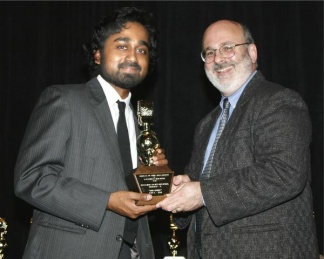
Credit: Henk Friezer
Fighting anti-gay bullying in the classroom with... theater
The death of Laurence King – killed by a junior high classmate in Oxnard in 2008 – highlights a big problem: If you're a teacher, how should you deal with homophobia in the classroom? One group is using theater to teach teachers how to counteract sexual bias in Southern California classrooms.
The teacher training program starts with a staged scene. Students walk into their high school English class talking about a kid who got beat up the day before.
Bruce boasts, “If Travis wanted gay rights, he got 'em. Rights, lefts, uppercuts, a kick to the face! Bam!” Ally says, “It's not funny, Bruce. He could have been killed!” The baiting escalates, and all the teacher, Mr. McGregor, can manage is “Uhhh, guys please, stop playing around.”
The program is put on by Encompass, a non-profit group that focuses on diversity issues in California schools, and I sat in on a preview session held for a group of school administrators, counselors, and teachers. The actors are students from the LA County High School for the arts.
According to the Gay, Lesbian and Straight Education Network, by the time they get to high school, ninety percent of lesbian, gay, bisexual, or transgendered students have experienced physical, verbal or sexual harassment at school. They’re more likely to skip school out of fear, don’t do as well academically as their straight peers, and are less likely to graduate.
It’s a tough situation for any teacher, but Skyler Jackson of Encompass says California teachers don’t have a choice after state lawmakers amended the education code in 2000 to “include sexual orientation and gender identity and those that are perceived to be different based on sexual orientation to be protected from bullying and harassment in schools. “
“They think in these trainings that we’re coming in to attack their views,”Jackson says, “particularly if their views are a bit more conservative than our organization. But he says there’s no “gay agenda.” Rather than taking sides, the training offers tools to help teachers recognize and address those issues in their class.
The teachers watching the scene where the classroom explodes were asked to come up with strategies for how the ineffectual Mr. McGregor could have acted differently at each of the crucial moments – starting with the talk about the fight. As people come up with solutions, Jackson writes them on the board: acknowledging the students’ concerns, not condoning hate speech, in one case using literature to address the kids’ issues.
Then, the scene is repeated, with the actors improvising based on the teachers’ suggestions. Things play out differently this time. The more aggressive students dial back their behavior. The name-calling and baiting stops. Mr. McGregor is in control – and the students are able to focus on their lesson. There’s no guarantee it’ll work like this in the real classroom, but Robert Sowell, who does diversity training for LA County Community Relations, says it was helpful and powerful to see the strategies acted out. “It made the teaching come home.”
Student actor Drew Cameron says, “hopefully teachers are watching this and thinking, here’s some students that are putting on a scene for us. Here are some students who are showing us how to be better teachers. “
… better teachers in a school where every student feels safe to focus on the job of learning.
GOOD Magazine tries to find the next big thing for 2012
Founded in 2006, GOOD Magazine dedicates itself to finding ideas that are sustainable, prosperous, productive and creative. In their latest issue, they try to find the next big thing. Ideas that would have an impact in the immediate future.
Amanda Hess, the Lifestyle Editor for GOOD, followed a porn star named James Deen who doesn't have the typical fan base one would expect. Hess says that "the community that seems to be most impressed by him are really young girls and I think part of that is because he's also young comparatively. He's 25 years old". Deen has been changing the way the porn industry utilizes male porn stars. His approachable looks and sensual gestures while he's in action "makes it really accessible and fun and not scary" for women according to Hess.
Zak Stone, the Daily Editor for GOOD, thought that high end expensive coffee bars would be the next big thing. "A lot of people in the coffee world will say that right now is the golden age of coffee. People in cities around the world have access to the best coffee that they've ever had access to," he says. Pricey places such as Intelligentsia and LA Mill in Silverlake serve coffee that costs up to $6.00 a cup. These places are continually expanding with places like Cafe Dulce popping up in Little Tokyo. Pasadena is now home to the newest Intelligentsia coffee house.
While Stone believes that high end coffee bars are on the rise, Time Fernholz, the Business Editor, predicts that Azteca TV, a Spanish language network in Glendale, might be the next big thing. Fernholz believes that "their challenge is that they want to reach younger people. There are a lot of second and third generation Latinos in the United States who don't necessarily want to watch what their parents and grandparents have been watching for a long time". Unlike Univision and Telemundo, Azteca focuses on programing that aims at a younger crowd, such as reality TV. Fernholz believes that it's a bold move for Azteca, one that could possibly affect his credibility as a Journalist. "If it works, maybe they will have a huge success and I will look really smart. But if they fail, then I'll just look like a big idiot, so that's Journalism."
Hank Rosenfeld answers, "What the %$#@ is Moomat Ahiko?"
The sign in Santa Monica hung over Off-Ramp contributor Hank Rosenfeld like an overdue DWP bill. "Moomat Ahiko." A small mystery he unravelled with the help of a chanteuse. (That's French for beautiful singer.)
Pacific Standard Time: Getty shows Valentine's big idea
It looks like one of the alien monoliths from "2001: A Space Odyssey." It's a 12' x 8', almost 2-ton, polyester resin sculpture made by De Wain Valentine in the 1970s. It encapsulates what "Pacific Standard Time" is all about: it's a groundbreaking piece, made here, and is a bear to take care of.
The Getty Conservation Institute’s Tom Learner says that Valentine’s piece was created in the mid-70s – after Valentine formulated his own brand of polyester resin.
“What’s special about De Wain’s pieces,” Learner says, “is that before, these resins could only be used to cast in quite small volumes. He wanted to go very, very large scale, so he had to invent a new resin.”
Learner says the “Pacific Standard Time” exhibition serves many purposes. Valentine’s gallery, for example, tells the story of how the piece was made, the invention of the new resin and the conservation complications.
“What we hope isn’t lost is … the fact that you can stare at this piece at different times of the day and it looks completely different,” says Learner. “As you walk around it, you will see different reflections and transparencies. You start to pick up on the surface itself.”
Sometimes the surface looks flat and perfect, at other times its ridges and imperfections are visible, he says. While some of those imperfections are due to regular wear and tear, much of the surface change occurs because of the resin itself.
“The resin actually keeps moving with age,” says Learner. “We think it’s fairly flat originally, but as it ages, these ridges develop on its surface.”
The exhibition faced a bit of conflict with the artist regarding the restoration of the piece, which could have easily been accomplished through sanding and re-polishing. But the institute decided not to.
“It’s really beautiful and very authentic that we’re not artificially taking it back to the 1970s feel,” says Learner.
He says that leaving the piece in its original state opens the debate of conservation and raises awareness of restorations' difficult dilemmas.
“Once you’ve done it [restoration], that’s it,” says Learner. “You’ve lost the original surface forever and you can’t put it back.”
Valentine’s gallery will be featured in the West Pavilion of the Getty until March 11.