




One year ago, Congress defunded public media. Now that we're 100% community funded, please become a sustaining member or increase your existing membership today.
California high-speed rail consultants flew first-class, visited bars on taxpayers’ money

Ian Choudri, CEO of California High Speed Rail, speaks during a press conference on the high-speed rail project at the Wasco Rail Yard facility in Wasco on Feb. 3, 2026.
(
Larry Valenzuela
/
CalMatters
)
California’s High Speed Rail Authority paid nearly $600,000 in unallowable travel expenses to “questionable locations that appear unrelated to state business,” including trips to gyms, a nightclub, an escape room, a tiki bar and a cigar lounge over a two-year period, according to an investigation released Tuesday by the inspector general that oversees the agency.
The report found that the agency routinely reimbursed consultants for trips that were unauthorized or poorly justified. Some consultants flew first-class and were reimbursed without questioning, in violation of contracts and state policies. One consultant flew his private plane from Washington, D.C. to California and was reimbursed for a premium fare.
“Paying for travel when it is not necessary or when it exceeds what is allowed by state regulations or the contract terms is waste of public funds and is behavior inconsistent with the Authority’s role as the steward of public resources,” the Office of the Inspector General report reads.
Matt Rocco, spokesperson for the high-speed rail authority, said in a written statement that the agency “takes these findings seriously” and will work with the inspector general’s office to fix the issues.
-
 Sections of the coastal trail have been closed over the last two years.
 -
 This Sunday, Oct. 11, a 6.5-mile stretch of road will be closed to cars from Mariachi Plaza to Echo Park for CicLAvia Heart of LA.
 -
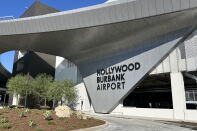 Hollywood Burbank Airport is trading its old 1930s terminal for a sleek new one that’s slated to open Oct. 13. Here’s what you should know before you go.


“In response, the Authority will strengthen internal controls around consultant travel, implement more rigorous documentation and approval requirements, and recover any improper costs identified,” he said.
Voters in 2008 approved a plan to build a high-speed rail line stretching from San Francisco to Los Angeles by 2020 at a projected cost of $33 billion. Since then, its route has been significantly scaled back, and the cost has ballooned to at least $126 billion. No tracks have been laid.
Sponsored message
The inspector general reviewed $1.15 million out of more than $2 million in travel reimbursements to four outside consulting firms between 2024 and 2026. The OIG said the firms are KPMG LLP, a global financial consulting firm; Nossaman LLP, a national law firm; AECOM-Fluor Joint Venture, which manages and coordinates the authority’s projects, and SYSTRA/TYPSA Joint Venture, which provides tracks and systems design.
None of the firms immediately responded to CalMatters’ requests for comment.
The report found the high-speed rail authority greenlighted at least $685,000 — roughly 60% — in payments without first approving the travel. In some cases, agency staff didn’t even know about the trips until they received invoices.
Even for approved trips, the report found the agency failed to sufficiently vet the requests and lacked records to justify the need for the travel.
The authority frequently approved expenses with vague justifications, such as “typical M-F week” trips, and approved travel at the request of executives without asking why. One consultant flew to California from Denver 20 times during the two-year period to “meet with the executive team” or attend executive meetings, without explaining why the meetings couldn’t have been remote, the report says.
One legal consultant was paid $40,800 in travel reimbursements and an additional $86,500 in “travel time” for 30 trips between Denver and Sacramento in a year. The same consultant “frequently booked flights on the same day the traveling occurred,” the report said.
When questioned about whether he needed to attend the meetings in person, the consultant said the authority’s chief executive, Ian Choudri, had requested his presence so he did not need to justify it and that it would not be appropriate for him to question Choudri’s direction, “as other consultants in other Authority offices are learning the hard way.”
Sponsored message
Nearly $600,000 of the $1 million in travel expenses violated state travel policies or the contracts, the report found.
The questionable expenses included:
- Premium Uber and Lyft rides to and from a restaurant, bar, and nightclub between 9:40 p.m. and 2:30 a.m. that “clearly appear to be for personal enjoyment rather than for the benefit of the state;”
- Numerous meals in Folsom, where CEO Choudri has a home;
- Repeated reimbursed ride-hailing trips to Planet Fitness gyms in and around Sacramento, even after a supervisor wrote that "the state does not cover ride share[s] to gyms";
- $118,000 in international travel despite the contracts explicitly barring international travel;
- A nearly $40 Uber Black luxury car charge for a trip of less than one mile in downtown Sacramento.
Protect free press
Financial adviser KPMG was the consulting firm that billed the authority for trips to the nightclub, the tiki bar and the cigar lounge, Deputy Inspector General Amanda Millen told CalMatters.
“It is important to remember that the critical issue here is not why the consultants visited these locations, but why (High-Speed Rail Authority) consultants included rideshare costs to these locations in their travel claims and why HSRA paid the cost of rideshares to these locations without questioning the business need for these costs,” Millen said in an email.
The report sparked instant outrage from Assembly GOP Leader Alexandra Macedo of Visalia, who called the spending “wasteful and unallowable.” She has been a vocal critic of the project even though Visalia sits along the planned route of the high-speed rail tracks.

Construction on the high-speed rail project over a ramp above Highway 99 in south Fresno on March 3, 2023
(
Larry Valenzuela
/
CalMatters/CatchLight Local
)
Sponsored message
The investigation is the latest wrinkle in the high-speed rail authority’s already troublesome history. The office of inspector general warned in a scathing July report that the agency could run out of cash by December 2027, raising doubts about its ability to finish its planned segment connecting Merced to Bakersfield.
Lawmakers this year approved Assembly Bill 1608, which would strengthen the inspector general’s oversight of the agency. Gov. Gavin Newsom has until Sept. 30 to sign or veto it.
In the new investigation report, the inspector general’s office made several recommendations to help the authority better enforce its travel policies. The authority should require travel expenses to be cost-effective, capped at state employee reimbursement rates and only for state business, the office says. The agency should also send a memo from the chief executive reiterating that all travel be approved in advance, even when the executive requests it, and that the agency review the expenses for the four contractors and seek reimbursement for unjustified travel.
In response, authority officials agreed to adopt some recommendations and partially adopt others by March 2027, including that it would send a memo from the chief executive clarifying travel expectations by February 2027 but it would be issued “‘at the appropriate executive level’ indicating that it may not come from the CEO.”
But the authority insisted it didn’t need to justify each consultant’s trip, prompting the inspector general to reply: “We explained to the Authority that this interpretation is fundamentally incorrect.”
The office will conduct another evaluation after March 2027.
This article was originally published on CalMatters and was republished under the Creative Commons Attribution-NonCommercial-NoDerivatives license.

Senior Vice President News, Editor in Chief


