




One year ago, Congress defunded public media. Now that we're 100% community funded, please become a sustaining member or increase your existing membership today.
Measles cases are rising in the US. Do adults need a vaccine booster?

Measles spreads easily. It's one of the world's most contagious diseases.
(
Natalya Maisheva
/
Getty Images
)
Listen
2:32
As measles cases rise, it's not just kids who need vaccines. Some adults do too
A measles outbreak in West Texas is continuing to spread. And with kindergarten vaccination rates dipping across the country, more communities may be at risk of outbreaks.
But it's not just kids who should be vaccinated. Infectious disease experts say some adults may need to get revaccinated, too.
Measles can spread incredibly fast — it's one of the world's most contagious diseases, more than flu, polio, COVID, or just about any other infectious disease.
Dr. Paul Offit, director of the Vaccine Education Center at the Children's Hospital of Philadelphia, notes that just last week, West Texas was reporting 14 cases. This week, it's up to 58 cases. "It's very hard to control measles," he says.
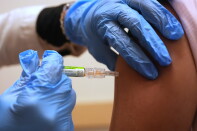
The best defense against measles is vaccination. The vast majority of people getting sick in Texas are unvaccinated. And the measles vaccine is both safe and highly effective, says Dr. William Schaffner, a professor of infectious diseases at Vanderbilt University Medical Center.
-
 Flu season typically starts in October or November. But it looks like the flu started to pick up in September this year.
 -
 As checks from President Donald Trump for health costs hit millions of mailboxes, a poll shows Americans don't trust Republicans on healthcare.
 -
 Environmental groups are seeking to force the release of public records and data related to the fire, officials’ response and potential health risks to the community.


"If you have been vaccinated with two doses of vaccine as per routine, you have a 95-plus percent chance of being completely protected throughout your life," Schaffner says.
Sponsored message
But public health experts say there are some adults who should consider getting revaccinated. That includes older adults who were born after 1957 and were vaccinated before 1968.
That's because early versions of the measles vaccine were made from an inactivated (killed) virus, which didn't work particularly well, Offit says. That's why the Centers for Disease Control and Prevention recommends that anyone vaccinated before 1968 get at least one dose of the live attenuated vaccine.
Before the first measles vaccines were developed in the 1960s, nearly everyone got the disease during childhood. So people born before 1957 are assumed to have natural immunity.
Schaffner says if you're not sure of your immunity or vaccination status, there's no harm in getting a shot.
If you were vaccinated between 1968 and 1989, you likely received just one dose of the measles vaccine, instead of the two doses that are standard today. One dose alone is highly effective and for most people, it provides more than enough protection, says Dr. Adam Ratner, a pediatric infectious disease specialist in New York City and author of Booster Shots, a book on the history of measles.
But Ratner says there are several situations in which the CDC recommends an additional dose of measles vaccine for adults who are considered at high risk. That includes people who are in college settings, work in health care, live or are in close contact with immunocompromised people, or are traveling internationally.
"If you're traveling somewhere where there's an active outbreak and you're not sure that you got two doses, it may not be crazy to get a second dose," Ratner says.
Sponsored message
And if you live in a community that is experiencing a measles outbreak, your local or state health department may recommend a second dose for adults.
It's worthwhile to make sure you're protected, because adults over 20 are more likely to develop complications from measles, which can include pneumonia and brain swelling.
And measles can also be dangerous — if not deadly — for children. As many as 1 in 20 kids with measles will get pneumonia, and 1 out of 1,000 will develop encephalitis, or brain swelling — which can lead to death or cause deafness or intellectual disabilities.
Nationwide, kindergarten vaccination rates have fallen below the 95% threshold that the Centers for Disease Control and Prevention says is needed to prevent community outbreaks. In some parts of the U.S., rates are far lower. That includes Gaines County, Texas, the epicenter of the state's outbreak, where the vaccination rate is only at about 80%.
Offit says vaccination is the best way to protect children.
"I lived through the 1991 Philadelphia measles epidemic, where there were 1,400 cases and nine deaths over a period of three months," he says. "So I've seen children suffer needlessly because of the choice not to get a vaccine. So, please vaccinate your children."
Edited by Jane Greenhalgh
Copyright 2025 NPR

Senior Vice President News, Editor in Chief


