




One year ago, Congress defunded public media. Now that we're 100% community funded, please become a sustaining member or increase your existing membership today.
What The Displacement Of Storied Restaurant Suehiro Means For Little Tokyo

Junko Suzuki (middle), her mother (right), and one of the waitresses at Suehiro Cafe (left).
(
Courtesy of Kenji Suzuki
/
Courtesy of Kenji Suzuki
)
Listen
26:34
Evicted From Little Tokyo - What's Next For Suehiro Cafe?
#217: Little Tokyo is losing legacy businesses, and the neighborhood gets a little less Japanese-American with each one. The latest to leave is iconic restaurant Suehiro Cafe - which opened in 1972. Second-generation owner Kenji Suzuki joins us to talk about his family's history with the restaurant, and what's next for them and for the rest of the Little Tokyo community. Suehiro Cafe is now operating out of their new location at 400 Main St., a few blocks south of Little Tokyo. Guests: Kenji & Tomoko Suzuki, owners of Suehiro Cafe; Mariko Lochridge, small business programs coordinator at Little Tokyo Service Center Music in this episode composed by:cero, Dexter Thomas, Evan Jacoby, Frankie Reyes, Geir Sundstøl, 細野 晴臣, Ill Considered, カシオペア, K. Leimer, ランプ, Maston, Roedelius, 高橋 幸宏, Woo
Listen
26:34
Evicted From Little Tokyo - What's Next For Suehiro Cafe?
Little Tokyo is no longer the neighborhood it was when Suehiro Cafe first opened its doors in 1972. Back then, there were hundreds of family owned businesses, and thousands of Japanese and Japanese American families called it home.
But it's changing.
Little Tokyo is 'kind of bleeding'
There are still plenty of Japanese bakeries, gift stores, mochi and sushi spots, but as you walk along historic First Street you’ll see several long-standing businesses that have closed or face closure, and the number of Japanese or Japanese American residents within the neighborhood’s official borders has dwindled to just a few hundred, according to census data.
-
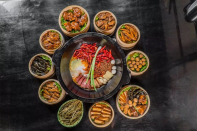 Explore the differences between traditions, from Sichuan’s spicy mala to Japan’s delicate shabu-shabu and Korea’s hearty jeongol.
 -
 These LA-area restaurants could also receive a Bib Gourmand affordable dining award or even a star at the awards event in August.
 -
 Feeling beachy, even if you're not near the ocean? Maybe a quality fish taco could hit the spot.


Little Tokyo Arts & Gifts closed its doors on Jan. 1, 2024, when owner Elaine Taiyoshi received an eviction notice. Shabu Shabu House, the first shabu shabu restaurant in the U.S., closed in late 2023.
Sponsored message
Suehiro is the latest legacy business to close in Little Tokyo, serving its last meal in the neighborhood on Jan. 9. The How to LA team was there Sunday to enjoy one last lunch and talk with Kenji Suzuki, the second-generation owner of the restaurant.
“Little Tokyo I think is kind of bleeding,” says Suzuki. “It's bleeding its soul.”

Little Tokyo’s First Street in 1942. The Sperl building where Suehiro Cafe was located is the shorter one, second from right.
(
LA Public Library
/
LAist
)
Suzuki’s business was evicted after a prolonged legal battle with his landlord Anthony Sperl, whose family has owned the building since its construction in 1882.
He says he’s not sure what will next occupy his former space, but he says he heard a permit application was filed for a cannabis dispensary with the same address. Suzuki has also heard there may be a tattoo shop coming to the building.
“He basically told us that he wanted to create a place more like Melrose,” says Suzuki. “Bringing in things that really have nothing to do with the Japanese community. And that's the reason why he wanted us to go, because we didn't fit in with his plan.”
How Suehiro began and built a community
Suzuki says when his mother and aunt started Suehiro Cafe, their original dream was to build a mahjong parlor.
Sponsored message
“While they were looking for a space, my father's friend — who was a cook at a restaurant here in Little Tokyo — wanted to have his own restaurant, but he just needed a partner,” he says. And so Suehiro Cafe, originally “Suehiro Restaurant,” was born.
“I think within the first year things start to falling apart,” Suzuki says with a laugh. “This cook left, and it was just my mother and my aunt by themselves — two women with absolutely no business experience, no restaurant experience.”
That’s when they started serving their trademark comfort food, he says. It was all they could do.

Junko Suzuki (right) serves a customer at Suehiro Cafe’s counter.
(
Courtesy of Kenzi Suzuki
/
Courtesy of Kenzi Suzuki
)
“The message my mother gave me was, ‘Whatever you like to eat, put on the menu.’ It wasn't anything complicated. It wasn't anything beautiful. It was, in the true sense of the word, just comfort food, because we didn't have a real chef.”
But Suzuki says if it wasn’t the food that hooked early customers, it was his mother’s charm.
“When she welcomed you, you really felt it,” he says. “When she asked you to please come back, you almost felt an obligation. Even to this day we have customers that come in from overseas and they want to make sure they come back here because they still remember my mom.”
Sponsored message
Junko Suzuki retired in 2001, passing the business to her son, Kenji. She died during the COVID-19 pandemic after contracting the virus.
“We've been in Little Tokyo for the last 52 years now,” he says. “This is our home, our roots are here, my mother put in a lot of work to keep things going.”
A neighborhood relationship
When Suehiro Cafe started having trouble with their landlord, Suzuki reached out to the Little Tokyo Service Center (LTSC). It’s a nonprofit organization that focuses on housing and community preservation. It also owns several buildings throughout Los Angeles, where they say they try and foster culturally appropriate small businesses.
“There was a time when no one wanted to be in Little Tokyo, and no one really wanted to be in downtown,” says Mariko Lochridge, small business programs coordinator for LTSC. “A lot of businesses left Little Tokyo and went to the South Bay area.”
But Lochridge says Junko Suzuki was adamant about staying in the neighborhood and in the Sperl building.
“She felt that since they helped [the cafe] during a tough time, she and her family should stay and stick it out,” Lochridge says.
Sponsored message
That decision came with financial risk, but ended up paying off as the neighborhood began to see huge influxes of tourists and non-local shoppers.
But Suzuki’s patience wasn’t rewarded, Lochridge says. “Now that the neighborhood's doing well, it feels like, ‘they're saying OK cool, thanks for getting us through that rough patch, now goodbye’.”

Interior of Suehiro DTLA’s new counter.
(
Courtesy of Suehiro Cafe
/
LAist
)
Lochridge says that when businesses like Suehiro leave the community, there is a real fear that it diminishes the cultural significance of Little Tokyo — especially when they’re replaced by non-Japanese stores.
“Back in the day there were hundreds of family owned businesses in the neighborhood and hundreds of families that lived here, so it was very easy to be connected.”
But now, she says, maintaining a relationship with Little Tokyo requires a much more intentional approach.
What's next
Suzuki’s new location in Downtown Los Angeles’ Historic Core is now open for business, and it’s several times larger than the original location in Little Tokyo. It will eventually feature a small museum on the bottom floor. This is where Suehiro’s famous lunch board will continue to live, plus one of the original wooden booths, and the plastic food display that lined the storefront windows.

Kenji Suzuki poses in front of a mural of his aunt and mother, painted by Robert Vargas, at Suehiro's new location in DTLA’s historic core.
(
Josie Huang
/
LAist
)
“We have a big mural of my mom and my aunt at the new location,” Suzuki says. “Every day I look at it and I tell my mom, 'make sure that you don't let me quit.'”
Despite his feeling of grief about leaving the community where he grew up, the younger Suzuki says he’s hopeful for the future of Suehiro Cafe.
“Twenty years from now I hope to be able to tell my landlord thanks for evicting us,” he says. “I’ll say, ‘now we have a bigger store, a better store, more customers.’ That's where I'm putting all my energy, to make sure that the new place works.”

Senior Vice President News, Editor in Chief


