




One year ago, Congress defunded public media. Now that we're 100% community funded, please become a sustaining member or increase your existing membership today.
International students worry as SoCal universities pause work authorizations


Students at UCLA on the Janss steps. The university has paused issuing work authorizations to international students.
(
Ashley Balderrama
/
LAist
)
The Department of Homeland Security says they have put some colleges and universities “on notice” that they could be in violation of federal rules that dictate work opportunities for international students.
The directive has left some of those students feeling worried, as their schools pause opportunities to work in the United States.
And experts warn that it could have adverse effects on U.S. industry and global growth.
What does DHS say?
In late August, the Student and Exchange Visitor Program, part of the Department of Homeland Security, issued a statement stating that they have “observed a rise" in violations related to Curricular Practical Training.
-
 President Donald Trump’s administration is on track to deport about 660,000 people over the past year, a new report released Thursday shows.
 -
 Groups are sharing ways to respond to ICE activity and training community members on voter protection ahead of the November election.
 -
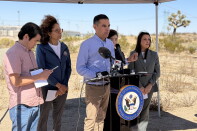 The representatives said it appeared the facility had been cleaned just before the tour started.


CPT is paid or unpaid work that students do as part of their degree program, like an internship. The administration says regulatory requirements permit CPT only where the training is “an integral part of an established curriculum.”
Sponsored message
In a written statement, an unnamed DHS spokesperson told LAist, “Nothing about these regulations has changed. However, schools and employers should consider themselves on notice: under President Trump, abuse of this generous system will no longer be tolerated.”
LAist reached out to DHS for the percentage increase in CPT violations and specifically asked for data related to Southern California schools. We have not received an answer.
How have local universities responded?
Following the memo from the department, several universities including the University of Southern California, UCLA and UC Berkeley have paused or required additional information to determine if work experience is a requirement for a particular degree program.
In a written statement to LAist, a spokesperson for the UCLA Dashew Center said, “UCLA has paused certain Curricular Practical Training authorizations while the university reviews recent federal guidance and determines next steps. UCLA is communicating directly with students who have affected CPT applications and remains committed to supporting our international students as we navigate these changes.”
Why it matters
For students, this is causing uncertainty.
Sponsored message
“It came as a surprise to all the international students. We were not aware of it and there is a lot of tension among the international students,” said Nitesh, a student from India at USC. He asked that we only use his first name for fear of repercussions from speaking to the media.
Those who applied for CPT authorizations after Aug. 23 at USC now are in limbo waiting to see if their applications will be approved.
”It is a real industry exposure to us when it comes to learning,” Nithesh said about the CPT component. “We definitely get lots of learnings and value from classes and by doing projects, but CPT is a way for us to understand what happens in the industry and keep us up to date.”
Nitesh, who took out an $85,000 loan to come to the U.S. for his degree program, said he would have reconsidered coming here had he known about these regulations ahead of time.
”Because there is a lot happening and nobody has clarity, so there is a lot of ambiguity, and we are just waiting for the right information to come in,” he said.
International enrollment impact
The memo is the latest in a string of directives targeting international students. Earlier this year, the Trump administration announced new rules limiting how long international students can remain in the country, as opposed to remaining in the U.S. for as long as it takes to complete their degree program.
Sponsored message
Santa Monica College has seen a drastic drop in international student enrollments: In fall 2016, the community college had more than 3,500 international students enrolled; that number has dropped to less than 1,600 this year.
Grace Smith, a spokesperson for Santa Monica College said, “In recent years, several interconnected federal restrictions continue to exert pressure on international enrollment and are likely to impact future enrollment cycles.”
Declining international student enrollment has a “significant impact on the college’s fiscal outlook,” Smith said as international student enrollment accounts for about 8% of the college’s unrestricted revenue.
Caltech’s president Ray Jayawardhana told LAist’s AirTalk program that he came to the U.S. as an international student from Sri Lanka.
“ Growing up in Sri Lanka, I thought of universities like Caltech in the United States as beacons on a hill,” he said. “They really were beckoning the best and the brightest from around the world, and I think it behooves us to preserve that attraction, preserve that draw, so that this country and the world at large benefits from students, from researchers, from scholars.”
While the uncertainties are “discouraging,” Jayawardhana said, Caltech is seeing “continued interest that's as strong as ever.”
Sponsored message
Listen
22:22
New Caltech president Ray Jayawardhana
Earlier this year, Ray Jayawardhana, astrophysicist and former provost of Johns Hopkins University, was named the 10th president of Caltech. Along with being the face of the school's operations, he is also set to oversee NASA’s Jet Propulsion Laboratory.
Hits to the U.S. economy
Rachel Banks, senior director for public policy and legislative strategy at NAFSA: Association of International Educators, said the current climate for international students is the “most difficult and most challenging” it has been since World War II.
“Having gone through the first [Trump administration], there were certain expectations of what we might see coming,” she said. “What I think was unexpected was the severity and degree to which we saw the Trump administration make moves specifically with respect to international students.”
Banks says her organization projects that the loss of around 111,000 international student enrollments could cost the U.S. economy $3.4 billion and nearly 4,000 jobs. California’s economy could see a hit of about $500 million because of declining enrollment.
The volume of visa revocations, particularly for students involved in campus protests for Palestinian rights, was “unprecedented,” she said. The State Department’s move to pause on interviews for visa applications and renewals was also something that hadn’t happened at this scale before, Banks said. And the new visa limits for international students, she said, is “incredibly disruptive” and takes the decision making away from students and universities.
The new memo about CPT authorizations adds to the uncertainty, she said.
Following World War II, the government put a lot of emphasis into fostering and developing our higher education system, Banks said, which allowed universities “to attract the best and brightest talent and that has led to the numerous innovations and achievements that we've been able to see come out of the United States.”
That talent, she said, will now look to go to other countries more favorable to international students.

Senior Vice President News, Editor in Chief


