






One year ago, Congress defunded public media. Now that we're 100% community funded, please become a sustaining member or increase your existing membership today.
A visit to MacArthur Park on a typical day makes this much clear: Local and federal officials have yet to bring down the park’s infamous underground drug market.
That doesn’t mean nothing has changed.
In 2023, a 35% spike pushed violence in and around the park to levels not seen in nearly three decades. Now, rates have fallen close to what they were before that spike began — although the area remains one of the most dangerous in L.A.
Still, more families are slowly starting to come back to the park and visit the shops that line Alvarado Street — shops that now have fewer people using drugs right outside their front doors.
The changes have made some in the community hopeful MacArthur Park will continue to become a safer place for families. Others worry some law enforcement actions may be doing more harm than good.
“It feels like there’s all this focus to clear the park,” said Mireya Valencia, president of the MacArthur Park Neighborhood Council, at an Aug. 5 council meeting. “All it’s doing is just pushing the issue onto our sidewalks and onto our doorsteps.”
Sponsored message
She has faced more safety issues on her block in recent months than she has seen in a long time, she said, even as the city tried to “put on a show” at the park during the World Cup.
I have spent more than a year reporting from MacArthur Park to understand the crises that have long made this stretch of the Westlake neighborhood one of the most dangerous parts of L.A., second only to downtown’s Skid Row. In that time, the city’s approach to the park has transformed.
A shooting, a fence and a promise
In the early hours of Jan. 22, 2025, a shooter wounded five people. It was the kind of violence that had persisted throughout the previous two years — and a worrisome signal that the new year could bring more of the same.
City leaders decided something had to be done.
Within days, Mayor Karen Bass called for increased LAPD presence and installed a temporary chain-link fence across from the park on Alvarado Street in an effort to disrupt the trafficking of drugs and stolen goods.
Community violence prevention workers contracted by the mayor’s office and Councilmember Eunisses Hernandez also stepped in to stop conflict from escalating between three gangs that claim territory in and around the park.
Sponsored message
Five weeks after the shooting, Bass celebrated what she said was a 57% decrease in violent crime in the area. Police data show that some of that improvement lasted through 2025, with a nearly 19% decrease in reported violent crime compared with 2024.
The fence, however, was immediately controversial. Residents said it was an eyesore, and it prevented longtime vendors from setting up their stands on the street.
Hernandez, who represents the district including MacArthur Park, told me she was not involved in the decision to install the fence. She said she was focused on working with the mayor’s office to develop permanent infrastructure like bike lanes, trees and solar street lighting.
“I believe that we should not be putting the crises of MacArthur Park on the backs of street vendors,” Hernandez said in March 2025.
City Councilmember Monica Rodriguez called using fences to obstruct vendors an “overcorrection” during a City Council meeting within days of the fence going up. She urged the council to find a balance across the city between enforcement against vendors who don’t follow the law and providing the support they need to become compliant.
Around MacArthur Park, though, vendors have been accused of more than operating without the right permits. Residents told me they saw some selling drugs and stolen goods. While no street vendors told me directly that they were coerced by gangs to sell drugs, some in the area said vendors they knew were being extorted and forced to pay “rent” to local gangs for their spaces on the sidewalk.
Bass said she understood there was some opposition to the fence. She also said it was an important step to bring down drug use around the park.
Sponsored message
“I have certainly seen drug use,” she told me in an interview a year after the fence went up. “But I will tell you that it is nothing like it was when the vendors were there.”
Bass said she didn’t see the vendors as criminals but as victims working under threat from gangs. Her focus, she said, was the traffickers.
One street vendor near the park, who asked to remain anonymous out of fear of retaliation, told me visible drug trafficking slowed after the fence went up. A man I met in the park, Anush, put it more plainly.
“It’s like 10 times as hard to find drugs now,” he said.
Anush also lamented that the fence forced out food vendors selling tamales and pupusas.
“F— the fence, dude,” he told me. “I’ll take fentanyl and pupusas.”
A note on sources
Some of the people who spoke to me for this series were involved in illegal activities, did not have legal U.S. residency status or feared for their safety if they talked to a reporter. In some cases, people agreed to use a first name or nickname to speak more openly about their situations. Others would only talk to me on the condition that they remain anonymous. I only used information from anonymous sources that was corroborated by others.
Sponsored message
Immigration raids change the tone
Federal immigration agents rode into MacArthur Park in armored vehicles, carrying assault rifles and escorted by National Guard troops. Border Patrol agents marched through the park, some on horseback, as protesters and journalists gathered nearby. By then, the usually busy park was empty of almost everyone else.
It was July 7, 2025, one month into a mass deportation campaign across L.A. County.

Federal agents descend on MacArthur Park in Los Angeles on July 7, 2025.
(
J.W. Hendricks
/
CalMatters
)

Federal agents ride on an armored vehicle driving slowly down Wilshire Boulevard near MacArthur Park in Los Angeles on July 7, 2025.
(
Patrick T. Fallon via Getty Images
/
AFP
)

Federal immigration agents poured into MacArthur Park on July 7, 2025.
(
U.S. Customs and Border Protection
)

Federal immigration agents poured into MacArthur Park on July 7, 2025.
(
U.S. Customs and Border Protection
)

Federal immigration agents poured into MacArthur Park on July 7, 2025.
(
U.S. Customs and Border Protection
)

Federal immigration agents poured into MacArthur Park on July 7, 2025.
(
U.S. Customs and Border Protection
)
That day, city officials — including Bass, City Council President Marqueece Harris-Dawson and Hernandez — denounced the Trump administration for what they called an effort to instill fear in Angelenos.
In the coming months, people in the neighborhood saw their friends and neighbors be detained or deported.

Mikem Nahmir stands in a crowd of protesters after federal immigration agents flooded MacArthur Park on July 7, 2025. “ If you come around me thinking you finna just grab somebody, I'm not about to get to chanting,” he said. “ I'm gonna punch you in your face.”
(
Jordan Rynning
/
LAist
)
After the raids, many street vendors, storefronts and restaurants reported taking an economic hit beyond anything they had seen in years — far worse than the COVID-19 pandemic.
At the same time, they told me federal agents who flooded the streets seemed to do nothing to stem MacArthur Park’s longstanding underground market of drugs and stolen goods.
An economic toll driven by immigration enforcement
By the end of August 2025, then-Homeland Security Secretary Kristi Noem was celebrating 5,000 immigration arrests in L.A., promising that it was “just the beginning.” By year’s end, the tally of people arrested was nearly triple that. Border Patrol and ICE agents around L.A. detained more than 14,000 people in 2025 — a sharp increase from 2024, when agents detained fewer than 5,000 people in total, according to an LAist analysis of DHS data acquired by the Deportation Data Project.
The risk for undocumented street vendors around MacArthur Park was clear: going to work meant risking separation from their families. President Donald Trump campaigned to return to the White House on the promise that he would deport the “worst of the worst” of undocumented immigrants. Many of those afraid to go to work said they have lived in the U.S. for many years, paid sales and other taxes and contributed to their communities.
“For the most part, the vendors aren’t going out after the ICE raids,” Veronica Lopez, a business counseling manager at the PACE Business Development Center, told me in November 2025. “Financially, they are suffering.”
Without their main source of income, she said, many were relying on their savings to get by. Not only was it not worth the risk to go to work, but clients told her they were afraid to go shopping or to community events, worrying that ICE would show up.
As their savings ran out, some people began to set out toward the park with their stands once again, even as the threat of being detained remained high.
One vendor, Magdalena Garcia, said she decided to go back to work near MacArthur Park in December 2025. Three weeks later, she witnessed immigration agents taking a colleague away.
“They took a fruit vendor,” she told me, speaking in Spanish.
She said, even months later, she still felt pain when she thought about what she witnessed. She said she agreed with the Trump administration removing serious criminals from the country. What’s not fair, she said, is that they seemed to be going after peaceful, hardworking people.
I talked with more than a dozen people who run shops and stands nearby. They told me the immigration operations, combined with rampant open-air drug use, violence and trash accumulation around the park, had caused an economic downturn far worse than the COVID-19 pandemic.
Even people who had lived in the area for decades said they no longer felt safe walking the streets around MacArthur Park. At night, I saw pedestrians running past Alvarado Street or walking on the roadway itself, risking being hit by a car to avoid passing too close to those selling drugs — or having to step over people passed out on the ground from drug use.
“After the pandemic, it’s gotten really awful,” Garcia said. “The fire department is always coming, the police are always passing by. It doesn’t feel safe anymore.”
Law enforcement focus on drug dealers is welcome
On March 5, 2026, the LAPD, FBI and other members of the Southern California Drug Task Force led by the Drug Enforcement Administration, or DEA, arrested 12 people alleged to be connected to drug trafficking near the park. During a three-day operation, law enforcement officials said they also seized 10 pounds of fentanyl, 5 pounds of methamphetamine and $80,000 in gang proceeds.
Government officials allege some of those arrested were leaders of the 18th Street gang. The LAPD and DEA describe the 18th Street gang as one of the largest in L.A., with roots going back to the 1960s. Both agencies say the gang now controls much of the drug trafficking in MacArthur Park and Skid Row, and that it operates under the direction of the Mexican Mafia — funneling new recruits into the mafia and handing it a cut of local proceeds, a practice law enforcement officials refer to as paying “extortionate taxes.”
LAPD Chief Jim McDonnell said one of the people arrested was Keiko Marie Gonzalez, 59, whom he alleged was enforcing control over the gang on behalf of Jorge Gonzales, 71. Prosecutors say Jorge Gonzales, who is incarcerated at a California state prison, was directing the gang’s operations by way of smuggled cellphones and that he is a member of the Mexican Mafia.
On top of drug charges, prosecutors allege Keiko Gonzalez ordered multiple killings targeting members of 18th Street, other gangs and drug dealers, including one dealer who was working in 18th Street’s claimed territory without paying the gang a cut. Gonzalez pleaded not guilty to these charges.
Those arrests only briefly depressed the local drug trade. Just weeks later, investigators saw a resurgence in drug sales at MacArthur Park.
On May 6, 2026, task force members arrested another 18 alleged drug dealers and distributors, including two people alleged to have been the main source of fentanyl and methamphetamine in MacArthur Park. Federal and local officials said they seized about 40 pounds of fentanyl powder at a single defendant’s residence in Calabasas. The DEA claims in court documents that the same defendant, 40-year-old Yolanda Iriarte-Avila, sold one kilogram of fentanyl powder to a confidential source for the agency in exchange for $10,000 in February 2026. DEA Special Agent in Charge Anthony Chrysanthis said the agency identified the source of the drugs as the Sinaloa Cartel.
“I promised our community members and warned the criminals that the LAPD would not stand idle if they dared to reorganize and continue their deadly trade,” McDonnell told reporters in the park. “As today’s operation illustrated, apparently some people didn’t get that message.”
Iriarte-Avila pleaded not guilty, court records show. Then, on Sept. 7, 2026, she signed an agreement with federal prosecutors that she would plead guilty to possession and intent to sell at least 400 grams of a mixture containing fentanyl.
Some residents told me the arrests began to bring a sense of hope that violence and drug use near the park could be reduced. Emma Carr, who lives nearby, said she was excited when she heard in June there would be more police activity around the park.
“I just moved out here about two years ago, and so having to witness and see all of this, it hurts me,” Carr said, describing how she regularly passes people as they use drugs on the sidewalk. “I have my young daughter and always having to tell people, ‘Excuse me,’ or, ‘Kids walking, kids walking.’”

Emma Carr stands with her daughter near MacArthur Park on June 4, 2026. “I just see it, my child has to see it. . . The homeless are just in a group huddling and this is really, really bad," she said, "I don't like living here and it's very inhumane.”
(
Jordan Rynning
/
LAist
)
A “significant dent” but a job still unfinished
Capt. Ben Fernandes, the LAPD’s area commanding officer for the Rampart Division, told me in June that the operations over the previous three months put “a significant dent” in the area’s fentanyl supply. But he acknowledged the job wasn’t done.
With other gangs like MS-13 and the Crazy Riders nearby, he said there is a risk they or others will try to step in where those who were arrested in recent months had been operating.
As drugs get harder to obtain, he said, people in the area suffering from addiction may also be more likely to steal or resort to violence.
To pay for drugs, people buying them around the park have often relied on what’s known as boosting — stealing items to resell them for a profit. It’s common for thieves to target big-box retailers, Fernandes said, but one small shop owner told me she had recently opened her shop’s doors to find thousands of dollars of products stolen overnight.
Mental health and drug treatment resources
- L.A. County DMH 24/7 Help Line (800-854-7771)
- SAMHSA National Helpline (1-800-662-HELP)
- If you or someone you know is in crisis and need immediate help, call the Suicide Prevention Lifeline at 988 or go here for online chat.
- Crisis Text Line (text HOME to 741741)
- Access map for naloxone access and other harm reduction supplies
Walking down Alvarado Street across from the park, you can see deals for anything from shampoo and cigarettes to expensive power tools and computer parts — many of questionable origin. One storefront worker told me not all of the shops buy and resell stolen goods, but if they don’t, they know someone down the street will.
Fernandes said the LAPD has been working with local store owners to catch the thieves, sometimes making 10 or more arrests at a time. But he said it is not only retailers who are at risk from people trying to score drugs.
“In the past, when the narcotics trade was flowing, they were able to get a chunk of fentanyl and then a bunch of [people] could sort of take pieces off of it,” Fernandes said. “And now they’re desperate just to get their own fix, not able to get a bigger piece.”
That desperation can lead to anything from shoving matches to someone pulling a knife or gun, he said, and someone getting hurt. Multiple people I talked to in the park said they regularly see people with knives or guns, and police data show those weapons were being used more and more often in violent crimes there until this year.
There have been fewer than half as many crimes involving firearms through September 2026 as there were over the same period last year, LAPD data show, and the department told CBS News in August that no one had been hit by gunfire near the park since January.
The reprieve from shootings ended Oct. 12, when a man was shot and taken to a hospital.
LAPD officers and federal drug enforcement agents have continued to conduct operations around the park. In June, they targeted those using drugs there when they made more than a dozen arrests and citations.
-
 L.A. Mayor Karen Bass said LAPD wouldn’t target drug users at MacArthur Park. Then LAPD did.
-
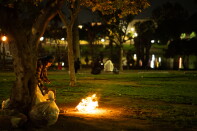 Curbing crime in the city’s most infamous underground market has proven a challenge for city officials, as overdoses outpace everywhere but Skid Row.


That month saw the end of large-scale operations in MacArthur Park, but Fernandes told me in an interview on Oct. 13 that the LAPD still has officers constantly policing the area.
He said they have since run into minor setbacks as some of the people they arrested during the drug enforcement operations were released from jail pending trial and have returned to the park. Now, Fernandes said, the department’s main priority is connecting people who are addicted to drugs with treatment services, while continuing to arrest dealers and violent criminals.
The L.A. County District Attorney’s Office has filed felony charges against four more people prosecutors allege to have sold drugs in the park in the past four months, according to records shared by the office.
One woman who works nearby said she has still seen violence at the park since June, including a machete attack and what she suspects to be the abduction of young women who were under the influence of drugs.
“I seen them every day because they was living out here,” she told me, talking about one of the women. “But since she got in the car with that person, I don’t see her no more.”
She said she has tried to intervene when she has seen other young women being lured into strangers’ cars.
Sometimes, she said, she has been successful in getting the women to stay by her side. She watched others be driven away, later recognizing them in parents’ photos as they searched the park for their missing daughters.
More uncertainty for vendors
After standing for nearly 16 months, the fence Bass installed across Alvarado Street was replaced in May by planters and large cement bollards, more permanent obstacles for street vendors who used to set up along the sidewalk.
Some store owners and vendors who stayed near the park say they appreciated the increased police activity that came with the fence, seeing more customers come through since the drug enforcement operations began in March. Business remained far worse than before the immigration sweeps, but was slowly getting better, some said.
In June, Fernandes told me the LAPD was trying to help vendors and shop owners near the park do business safely and legally.
“There are a lot of vendors out there that are just trying to provide for their families,” Fernandes said. “They’re just trying to make an honest living by selling food goods or other items. And what we try to do is be decent with them and work with them, you know, explain the rules.”
Then, as enforcement against people using drugs in the park increased, the rules for street vendors also seemed to change.
Vendors who had worked near the park for years say they were again pushed further out of the area by police officers who told them to pack up their things and move. At least three were cited in July on anti-camping violations for setting up their stands within 500 feet of the park, according to the Unión Popular de Vendedores, which represents vendors in the area.
Blanca Estela González told LAist reporter Julia Barajas and me that she has been selling things like clothes, shoes and coffee near the park for 18 years.
She said officers told her to pack up and leave her new spot in August, but she just wants to be allowed to work.
“Around here, if you don’t pay the bills, you end up on the street,” González said in Spanish. “So, how is one supposed to survive?”
A 2018 state law allows vendors to work without the risk of criminal penalties in most places where they don’t pose health, safety or welfare concerns. It is unclear who may have directed citations to be given, but Bass said they were issued by mistake.
“At the direction of Mayor Bass’ office, the LAPD has stopped issuing criminal citations to street vendors and is working to dismiss all criminal citations issued in error, ensuring they are not left with criminal records for working to provide for their families,” her office told me in a statement on Sept. 3.
“We’ve had each other’s backs”

Robert Escobar sells backpacks and strollers at the Bonito Swap Meet on June 15, 2026.
(
Jordan Rynning
/
LAist
)
Robert Escobar sells backpacks and strollers at the Bonito Swap Meet across Alvarado Street from the park.
The one-time movie theater is packed with dozens of people running stands like his, doing their best to weather the storms that have all converged around MacArthur Park: violent crime, the opioid epidemic and fears of immigration enforcement all taking their toll.
Escobar is hopeful that conditions will continue to improve over time, but says he wishes the area’s troubles didn’t keep visitors from meeting the great people he’s come to know there.
“I always hear people say, ‘Oh, you know, MacArthur Park this, MacArthur Park that,’” he told me. “But they weren’t here before it was all that — before it was too bad.”
Escobar found community with the vendors after coming to the area when he was about 9 years old. Now 19, he said they have watched him grow up.
“We’ve had each other’s backs,” he said, “through good and bad times.”
How to reach me
If you have a tip, you can reach me on Signal. My username is jrynning.56.
- You can follow this link to reach me there or type my username in the search bar after starting a new chat.
- For instructions on getting started with Signal, see the app's support page.
- And if you're comfortable just reaching out by email I'm at jrynning@laist.com.
How to get involved
- Apply to join a neighborhood council or weigh in at a meeting — the area is represented by the MacArthur Park, Westlake South and Westlake North neighborhood councils
- Contact your representatives
- Harm reduction / naloxone access — See a map of where naloxone and other harm reduction services are available
- Report park conditions — MyLA311 for city services (broken bathrooms, lighting, trash).

Senior Vice President News, Editor in Chief


