Academy Museum of Motion Pictures to move forward with building project
The Miracle Mile neighborhood of Los Angeles is set to get yet another cultural facility. Known as Museum Row, this stretch of Wilshire Boulevard is already home to the L.A. County Museum of Art, the Architecture and Design Museum, the Craft and Folk Art Museum and several others. Now, the way seems clear for the $300 million Academy Museum of Motion Pictures.
The Renzo Piano-designed space, which will include the former May Company building at Fairfax and Wilshire, hit some roadblocks this year.
A neighborhood group known as Fix the City threatened a lawsuit if the Academy of Motion Pictures didn’t address some concerns first, including how the new museum will affect traffic in the already congested Miracle Mile area. The Academy has just reached an agreement with Fix the City and The Frame’s John Horn spoke with Bill Kramer, managing director for the Academy Museum.
Interview Highlights
Back in June, the Academy got the go-ahead from the [Los Angeles] city council to start construction on the new museum. What happened?
Fix the City, a community group we’ve been speaking with since the beginning of the planning of the project, wanted us to commit to working with them on some monitoring and mitigation efforts tied to the project. So we waited. We extended the 30-day wait period to 60 days and by the end of August, which was the end of the 60 days, we were able to come up with an agreement that worked for us and Fix the City. At that point we were able to go to the Department of Building and Safety and secure our first permit to start construction.
What is Fix the City and have they had a history of dealing with other developers in terms of what their point of view is on the neighborhood?
They have. [Fix the City] is a community and advocacy group, really concerned with the quality of life in Los Angeles overall. Great group, very sage ... So when they looked at our project it was not about what’s just happening on [our] plot of land. It’s how that project is connected to everything else that is happening in that neighborhood. And [examining] how we can work together on mitigation efforts to really make the neighborhood remain livable while we create a world-class cultural institution for the city.
It sounds as if they had a couple of concerns, [including] signage. What about in terms of parking and traffic flow?
We’re not building new parking. We have secured over 800 spaces in the neighborhood for use at our most high capacity moments, which would be the weeknights and weekends ... In terms of traffic, we will monitor traffic flow — cars coming out of our area and the LACMA area to see who is using our museum. And if it becomes overly-trafficked, we will work with them on mitigation efforts, [such as] working with the city on putting speed bumps in, better signage, directing people to our parking areas, etc.
We know from the schematics from architect Renzo Piano’s plans that the museum will include a 1,000-seat theater and event space. What else can you tell us in terms of what will be in the museum and its design?
The 1,000-seat theater, the sphere, is the most apparent part of the project. But within the May Company [building] — a beautiful existing building with great bones — there are going to be six stories of galleries that will explore the history and future of moviemaking.
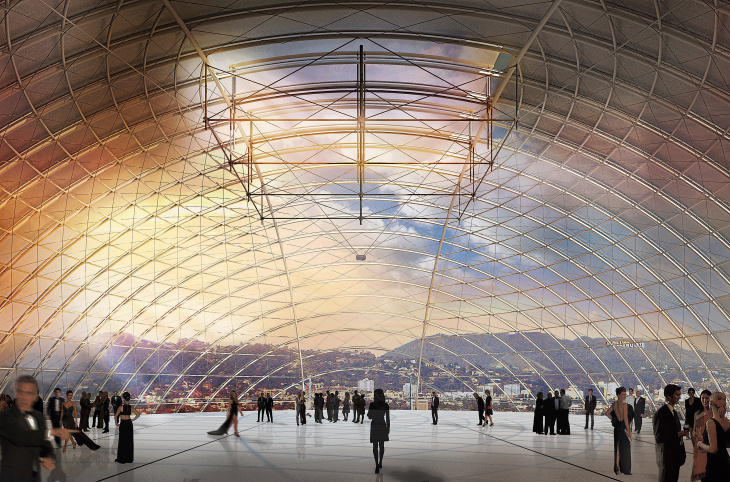 Academy Museum Rendering - ©Renzo Piano Building Workshop/©A.M.P.A.S.
You still have $50 million to raise. But with the Fix the City issue resolved, are there any other issues that remain as the building of the museum progresses?
Obviously, a project of this scale has many challenges that lie ahead, and we’re prepared to tackle them. It was very important to us to work with the community. We did not want to move forward with the project without the support of our neighbors, and we were thrilled that we were able to come to an agreement with them. They’re our greatest stakeholders. It’s their neighborhood and we would not feel comfortable moving forward without an agreement like the one that we’ve just secured.





